Women in World History...
Alexandra Gripenberg Sought Universal Human Rights
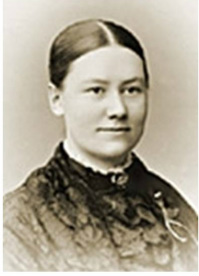
Alexandra Gripenberg-Wikimedia Commons
by Kathy Warnes
Alexandra Gripenberg of Finland agitated for universal
women’s rights and for poltical freedom for her native Finland and its citizens, especially women.
Women suffragists in countries including Norway, Great Britain, and Finland worked alongside American suffragists like Susan B. Anthony and Elizabeth Cady Stanton for the common cause of women’s voting and equal rights all over the world. Alexandra Gripenberg agitated internationally for women’s rights and she also helped develop the women’s movement during turbulent political times in her native Finland.
Alexandra Gripenberg Sends Elizabeth Cady Stanton A Letter
Today, Elizabeth Cady Stanton is an icon in woman’s suffrage history while Alexandra Gripenberg is less well known, even in her native Finland. Alexandra especially devoted herself to the cause of international cooperation in the women’s movement. She heavily influenced the women’s movement in Finland, serving for years as chairman of the Finnish Women’s Association. In 1907, she was one of the nineteen women elected to the Diet after Finland achieved universal suffrage
On a more personal level, Alexandra Gripenberg sent Elizabeth Cady Stanton a letter to congratulate her on her 80th birthday which her colleagues and friends gathered to celebrate at the Metropolitan Opera House in New York the week of October 15, 1895. Alexandra Gripenberg wrote her congratulations from Helsinki, Finland, and she told Elizabeth Cady Stanton that as the president of Finsk Kvinnoforening she and her organization sent her respectful greetings to Elizabeth on her 80th birthday.
Alexandra Gripenberg Is Born A Writer
Alexandra Gripenberg loved writing before she became a feminist and Fennoman. Born August 30, 1857, Alexandra was the eleventh of the twelve children of Baron Sebastian Gripenberg and Mary Louise Ohrnberg. Sebastian had established a career in the Army and served as director of the Mustiala, a well known agricultural institute. He also was a senator in Helsinki, Finland..
The Finland of Alexandra’s birth had been part of the Kingdom of Sweden from the Thirteenth Century to 1809, when Sweden ceded the region to the Russian Empire and it became the self ruling Grand duchy of Finland. During these years, Finnish nationalism focused on Finnish cultural traditions, including music and a distinctive Finnish language. Alexandra would heavily contribute to this Finnish nationalism.
When Alexandra was born, her family had already lived on their farm in Tervus Kurkjoki, located in Ladogakarelen for many years, but in 1863, Sebastian’s failing health prompted him to move his family to Majby farm in Kirkkonummi. He died in 1869, and his widow Mary Louise continued to live at Majby with their large family.
Just twelve years old when her father died, Alexandra hadn’t yet had any formal schooling, but her two big sisters, Mary and Elisabeth, were attending the girls’ school in St. Petersburg and they taught Alexandra a wide range of subjects from language and arithmetic to music and dance. She also learned Eanglish and an appreciation of literature.
During these years, Alexandra developed a love of writing and she spent many hours writing stories. For a time she worked as a secretary of Zachris Topelius, a journalist, author, historian, and rector of the University of Helsinki who read her stories and encouraged her to keep writing.. Impressed with Alexandra’s talent, Zachris Topelius helped her publish Tales of the Making in 1878. Alexandra and Toini Topelius, the daughter of Zachris Topelius, became good friends and they jointly edited the children’s magazine New Dragonfly between 1885 and 1889. They maintained a lifelong friendship and wrote to each other frequently.
In 1880, Alexandra’s mother Mary Louise died, and shortly after her mother’s death she lived with her sister Elisabeth Stenius in Kuopio. Elisabeth and her husband belonged to Finnish literary and political circles and Alexandra met writers and activists in their home. Her sisters Elisabeth and Mary heavily influenced Alexandra’s career choice, and eventually she moved to Helsinki wih her brother, Self.
Alexandra Gripenberg Becomes A Fennomen
After the Crimean War ended in 1856, the Finnish people fiercely debated their conceptions of the Finnish nation. A group of dedicated Finnish activists called the Fennomens founded the Finnish Party and agitated to raise Finnish language and culture from peasant status to the standard for national language and culture, while the opposition Svecomans defended the existing Swedish and ties to the Germanic world.
In 1884, with her good friends Toini Topelius and Lina Arppe, Alexandra founded the Finnish Women’s Association and elected Elisabeth Lofgren chairman. Alexandra devoted herself to her writing and published a short story collection called Straws.
In 1886, her novel, The Thickening Stage, appeared, again with the help of Zachris Topelius. The themes of the two books deal with feminist and Finnish national issues and Alexandra published them under her pen name Aarne.
Zachris Topelius and Alexandra’s other friends encouraged her to go aboard to study and seek new experiences to deepen her writing. In the autumn of 1887, Alexandra and Alli Trygg, a teacher and temperance activist, went to England. They had planned to study English literature, but in London, Alexandra received a letter from Elisabeth Lofgren that changed their plans.
Elisabeth asked her to extend her stay aboard and travel to the United States to represent the Finnish Women’s Association at an International Women’s Congress in Washington D.C. in March of 1888. Elisabeth Lofgren had planned to attend, but her plans had changed. Alexandra’s companion Alli had an invitation as well, so the two friends could represent Finland in the Congress.
In England, Alexandra Gripenberg had met Elizabeth Cady Stanton, who along with Susan B. Anthony had founded the National Women Suffrage Association in 1868. She also interacted with other famous American activists including May Wright Sewall and Francis Willard, and socialized with feminists from Scotland, France, Norway, Germany, Ireland, Canada, and India. The issues that the International Women’s Congress debated included controversial topics like Temperance, women’s work, charity, and political rights, especially voting for women. From 1883 until 1889, Alexandra served as treasurer of the International Women’s Association.
Alexandra Gripenberg Returns to Activism in Finland
Six months after the International Women’s Congress ended, Alexandra Gripenberg still remained in the United States, traveling around the country. When she returned to Finland in 1888, she had gathered and analyzed voluminous amounts of observations and interviews for her book, A Half Year in the New World, published in Finland in 1889. Her book included her report of the first International Council of Women.
One of the key points that Alexandra made in A Half Year in the New World, focused on the American woman and her various roles that allowed the home to function as a key to American society. The American trip was crucial to Alexandra Gripenberg’s women’s movement activities and her writing. When she published A Half Year in the New World, Alexandra abandoned fiction to focus on non-fiction moral and political work and also, as a Fenomman, she wrote her book in Finnish and began spelling her name Aleksandra in the Finnish way.
When Alexandra returned to Finland, she accepted the chairmanship of the Finnish Women’s Association in February 1889, the beginning of a long presidency that lasted until 1909 with a five year break from 1904-1909 in between.
Alexandra Gripenberg imprinted her presidency with her involvement in the International Women’s Movement and her operations in the local Finnish national movement. During her presidency she focused on the activities of working women and women’s rights and involved the Finnish Women’s Association in publishing activities. Alexandra’s books were published as were her lectures, biographies of famous foreign women and also, the Association’s own journal, the Kotija Yhteiskunta, that Alexandra edited. In 1893, Alexandra opened a youth library in the Finnish Women’s Association headquarters.
Alexandra Gripenberg And Voting Rights
The Finnish Women’s Association had listed voting rights as one of the top items on its agenda since its founding in 1884, but it took until 1904 to address the universal suffrage question.
The Finnish political situation with Russia constantly shredded the fabric of Finnish nationalism and even though the Finnish political parties had different views about managing Finland’s relationship with Russia, most Finnish people agreed that the Finnish Diet must survive. Alexandra encouraged Finnish women to agitate for the right to vote and work for women’s rights, and in 1906, Finland granted women the right to vote and to stand for parliamentary office, the first European country to do so.
In March 1907, Alexandra and eighteen other women from five different parties were elected to the Finnish Diet. She continued to work for women’s rights, especially working women’s rights, and Prohibition.In 1911, Alexandra Gripenberg officially represented Finland in the International Women’s Congress executive meeting in Stockholm, a distinction she had worked years to achieve.
As early as 1904, Alexandra Gripenberg’s doctors had told her she had diabetes and counseled that her health wouldn’t permit her to run for parliamentary elections in 1909. Her health continued to deteriorate and by 1913, she lived in a Swedish nursing home. In the autumn of 1913, she still led a few Finnish Women’s Association meetings, but on Christmas Eve 1913, her heart finally stopped.
Finnish, Swedish, and foreign newspapers printed obituary notices that chronicled Alexandra Gripenberg’s decades long and diverse efforts for woman suffrage and women’s rights both at home and internationally.
References
Dubois, Ellen. Women Suffrage and Women’s Rights. New York University Press, 1998.
Evans, Richard. The Feminists: Women’s Emancipation Movements in Europe, America, and Australia, 1840-1920. Barnes & Noble, London, 1977.
Freedman, Estelle. No Turning Back: The History of Feminism and the Future of Women.
Ballantine Books, 2003.
Fulford, Roger. Votes for Women: The Story of a Struggle. Faber & Faber, London. 1957.
Kraditor, Aileen S. The Ideas of the Woman Suffrage Movement, 1890-1920. W.W. Norton & Company, 1981.
Lewis, Richard D. Finland: Cultural Lone Wolf. Nicholas Brealey Publishing, 2004.
Matthews, Jean V. The Rise of the New Woman: The Women’s Movement in America, 1875-1939.
