WINDOWS TO WORLD HISTORY
  • Home
  • Bishop Walter Hawkins: Protected by the British Lion
  • World History Windows
  • The White Roses Defy the Nazis
  • Elias Lonnrot Compiles the Kalevala
  • Because You Were Here We Are Enriched
  • Provocative People
    • Stephane Hessel Wrote Indignez Vous
    • Writer Lafcadio Hearn Merged Greek and Japanese Cultures
    • Are Paul Redfern and the Port of New Brunswick Buried in the Amazon Jungle?
    • Hans Brinker, the Dutch Hero Who Isn't Really Dutch!
    • Rudolf Vrba and Alfred Wetzler Fled Auschwitz and Wrote a Report
    • Roman Emperor Caligula and His Legendary Lake Nemi Ships
    • Rabbi Robert Serebrenik Defies Adolf Eichmann to Save Luxembourg Jews
    • The Confederados Become Brazilian, but Honor Their Southern Roots
    • Pliny the Younger Wrote Letters about His Life in Ancient Rome
    • Hannes Hafstein, Iceland's Poet-Prime Minister, Works for a Cable
    • Mermen Are Important Players in Scandinavian Culture and History
    • William Tell, Mythical Hero, Mythical Historical Figure, or Both?
    • Fritz Thyssen Helped Finance the Nazi Party, but Later Changed His Mind
    • Leif Ericson and L'Anse Meadows
    • Sigrid and Eirikr Magnusson Contributed Much to Iceland's Culture
    • Clara and Henry Leffingwell - An English, Australian, and American Story
    • Per Jacobsen, Norwegian Ice Skater and Resistance Fighter
    • Poul La Cour Pioneered Wind Power in Denmark
    • Michel Linovich- an Italian in Napoleon's Grand Army
    • Solomon Linda, the Lion Sleeps Tonight
    • Sergei Rachmaninoff Composed Rhapsody at Senar, His Swiss Villa
  • Raoul Wallenberg, the Hero Who Never Returned to Sweden
  • Jean Baptiste Sipido Tries to Assassinate the Prince of Wales
  • The Legend of the Hermit of Cape Maleus in Greece Transcends Time
  • Happy Hands-On Historical New Year!
  • Christmas Around the World
    • A Christmas Tribute to Captain Henry Waskow
    • European Christmases in Centuries Past
    • Chasing and Capturing the Fugitive Spirit of Father Christmas
  • Women in World History
  • Madam Elisabeth Thible is the First Woman to Ride in a Free Floating Balloon
  • Nurse Edith Cavell Had The Courage to Die for Her Country
  • Gertrud Scholtz-Klink Followed Hitler Her Entire Life
  • Suzanne Valadon and Maurice Utrillo - Artists of Montmartre
  • SOE Agent Andree Borrel Lived Several Lifetimes in Her 24 Years
  • Queen Alexandra of Great Britain - Queen Victoria's Daughter-in-Law, Bertie's Patient Wife, and Her Own Person
  • Maria Gulovich Liu Joined the Czech Resistance, Won the Bronze Star and became an American Citizen
  • Francoise Marie Jacquelin, Lioness of Latour, Lioness of Acadia, Woman in her Own Right
  • Grand Duchess Marie Adelaide of Luxembourg is a Symbol of Effective Rule
  • Clara Zetin Speaks Against Hitler in the German Reichstag
  • Madam Sophie Blanchard - Official Aeronaut of the Restoration
  • Queen Amelia Maria, the Last Queen of Portugal, Stood Her Ground
  • Places for Posterity
  • Haunted Church Bells Ring in Boscastle and Tintagel in Cornwall
  • Vienna Plague Defenses Included Plague Hospitals
  • The Plundering Plague and the Downfall of the Republic of Venice
  • Ostend Belgium
  • Centuries of History and Ghosts Haunt Denmark's Dragsholm Castle
  • Does Jacques LeRay Chaumont Still Haunt Chaumont Castle?
  • Soldier's Stories
  • Napoleon Bonaparte Ignores His Little Red Man of Destiny
    • The French Revolution Has More Phases than the Moon!
    • Napoleon Bonaparte Still Owes Innkeeper Hippolyte Baretta Sixty Francs!
    • Australian War Correspondent Alan Moorehead Returns to His Roots
    • General Christian Christensen is a Dual Citizen of Denmark and the United States
    • In 1919, Villagers and Soldiers Helped Rebuild Chateau-Thierry
    • The Dudman Family Lived the Meaning of Patriotism and Sacrifice During World War II
    • Five French Boys Canoe the English Channel
    • Stalin's Spin Doctors
    • Maurice Maeterlinck Encounters American Customs
    • Carl von Ossietzky Wins the Nobel Prize While in a Nazi Prison Camp
    • Flying Kites Through All Seasons, Countries, and Histories
  • World History 101
    • Pieces of World- History Puzzle
    • World History Puzzles - the Old World Meets the New World

Rabbi Robert Serebrenik Defies Adolf Eichmann to Save Luxembourg Jews

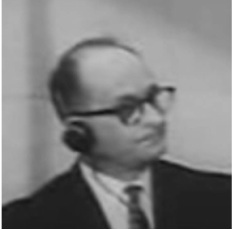
Picture
Adolf Eichmann - Wikimedia Commons
 

by Kathy Warnes

Rabbi Serebrenik opposed Adolf Eichmann’s Jewish policies, but he never dreamed that he would confront Eichmann himself in his office in Berlin.

Rabbi Dr. Robert Serebrenik had been appointed Chief Rabbi of Luxembourg in 1929, at the age of 28 and in 1930, he married Julia Herzog. When the German army invaded the Netherlands, Belgium, and Luxembourg on May 10, 1940, it conquered Luxembourg within several hours. On that same day, Rabbi Serebrenik helped nearly 1,000 Jews flee from Luxembourg into France and Belgium. Ultimately, many of them reached safely in Spain, Portugal and countries in the Western Hemisphere.

Rabbi Serebrenik and German Contacts Work to Save Jewish Lives


From the time the first German jackboot touched Luxembourg soil, Rabbi Serebrenik mediated between the Nazi invaders and the Jewish community to save as many Jewish lives as he could. In August 1940, Rabbi Serebrenik and a German officer contact, Freiherr von Huene-Horningen, worked to foil a plan to deport all of the Jews of Luxembourg, about 5,000 of them in 1940, either to Eastern European ghettos or concentration camps.

In November 1940, the Nazi’s implemented racial purity laws and arrested many Jews and confiscated their property. During these perilous times, Rabbi Serebrenik organized secret escapes of Jews into southern unoccupied France and official convoys of Jews with proper papers out of Luxembourg to Lisbon.

Rabbi Serebrenik Travels to Berlin to Negotiate with Adolf Eichmann


Many times,Rabbi Serebrenik traveled alone to Berlin to negotiate with German officials to save the Jews of his community. He was summoned to Berlin on March 20, 1941, but this time under different conditions.

As Rabbi Serebrenik recalled it in his court deposition for the Trial of Adolf Eichmann, “After the German occupation I was in Berlin several times, with the permission of the German authorities, for contact with Dr. Eppstein of the Reichsvereinigung. I want to add that I always travelled alone, without police escort. On 20 March 1941, I was called to Rauner, the head of the Jewish section, and he informed me that on 23 March, I would have to go to Berlin with two Gestapo men.”, in order to appear before Eichmann.

By this time Rabbi Serebrenik had heard from his contacts in the German military that the Nazis were committing horrific acts against Polish Jews. They also told him that new camps awaited Jews transported east and that being transferred to the east would be “worse than Dachau.”

The Gestapo agents brought Rabbit Serebrenik to Gestapo Headquarters to meet Adolf Eichmann. He noted that Eichmann wore elegant civilian clothes and was seated behind a desk. As Rabbi Serebrenik approached the desk, Eichmann shouted, “Three paces from my body, Jew!”

After Rabbi Serebrenik backed up, Eichmann began to talk to him, demanding to know what he intended to do with the Jews of Luxembourg. Rabbi Serebrenik told Eichmann that he had a plan for transferring Jews to Lisbon. Eichmann told Rabbi Serebrenik that he had eleven days to find a way to get the Jews out of Luxembourg.

Eichmann Tells Rabbi Serebrenik to Get the Jews Out of Luxembourg

On March 26, 1941, Rabbi Serebrenik returned to Luxembourg with only eight of the eleven days that Eichmann had granted him remaining. At this point there were about 1,000 to 1,100 Jews left in Luxembourg out of the original 4,000. Rabbi Serebrenik’s plan to rescue all of them failed, but somehow during April, May, and June of 1941, he managed to organize a transport of another 250 Jews to Lisbon.

One night in May 1941, as Rabbi Serebrenik walked home from the Great Synagogue of Luxembourg Nazi thugs jumped him and beat him nearly to death. On May 16, 1941, shortly after Rabbi Serebrenik was attacked, the Nazis began to demolish the Great Synagogue of Luxembourg, piece by piece, in what would turn out to be a two year task.

Rabbi Serebrenik, His Wife and Other Jewish Refugees Arrive in New York


The Rabbi and his family didn’t stay to see the final stone of the synagogue unturned. In June 1941, Rabbi and Mrs. Serebrenik arrived in New York with 61 other refugees from Luxembourg. By June 1942, the Jewish refugees had rallied and founded the Congregation Ramath Orah which is Hebrew for ‘Mountain of Light,’ in Manhattan, New York.

Most of the remaining Jews in Luxembourg were imprisoned at Funfbrunnen, a concentration camp near Troisvierges. From Funfbrunnen, about 696 Jewish prisoners were deported to ghettos, labor and extermination camps. Altogether, 1,945 of the 5,000 Jews in Luxembourg before the war died, while 1,555 survived by fleeing, hiding, or surviving imprisonment.

Rabbi Serebrenik and Adolf Eichmann Meet Again in a Court Deposition at Adolf Eichmann's Trial


After years of living a newly created life in Argentina, Israeli Mossad agents captured Adolf Eichmann and brought him to Jerusalem. An Israeli court indicted him on 15 criminal charges, including crimes against humanity and war crimes and his trial was held in Jerusalem in 1961.He was convinced and hanged in 1962, the only person to have been executed in Israel after being convicted by a civilian court.

Rabbi Serebrenik was not called to testify at Eichmann's trial, but he "happened" to be in Jerusalem, and made a deposition for the court, which it accepted as additional evidence.

References

Arblaster, Paul, A History of the Low Countries, Palgrave Macmillan, 2005

Blom, J.C.H., History of the Low Countries, Berghahn books, 1999

Nicholson, Marguerite Thill-Somin, Surviving the Nazi occupation of Luxembourg: A Young Woman’s WW II Memoir, Xlibris, 2008

Reid, Andrew, Luxembourg: The Clog-Shaped Duchy: A Chronological History of Luxembourg from the Celts to the Present Day, Author House, 2005

Zariz, Ruth and Lasch, Hannah, The Jews of Luxembourg during the Second Wrold War, Holocuast Genocide Studies, 1993: 7:51-66

Robert Serebrenik, Rabbi, is Dead at 62, The New York Times, February 12, 1965


Powered by Create your own unique website with customizable templates.
  • Home
  • Bishop Walter Hawkins: Protected by the British Lion
  • World History Windows
  • The White Roses Defy the Nazis
  • Elias Lonnrot Compiles the Kalevala
  • Because You Were Here We Are Enriched
  • Provocative People
    • Stephane Hessel Wrote Indignez Vous
    • Writer Lafcadio Hearn Merged Greek and Japanese Cultures
    • Are Paul Redfern and the Port of New Brunswick Buried in the Amazon Jungle?
    • Hans Brinker, the Dutch Hero Who Isn't Really Dutch!
    • Rudolf Vrba and Alfred Wetzler Fled Auschwitz and Wrote a Report
    • Roman Emperor Caligula and His Legendary Lake Nemi Ships
    • Rabbi Robert Serebrenik Defies Adolf Eichmann to Save Luxembourg Jews
    • The Confederados Become Brazilian, but Honor Their Southern Roots
    • Pliny the Younger Wrote Letters about His Life in Ancient Rome
    • Hannes Hafstein, Iceland's Poet-Prime Minister, Works for a Cable
    • Mermen Are Important Players in Scandinavian Culture and History
    • William Tell, Mythical Hero, Mythical Historical Figure, or Both?
    • Fritz Thyssen Helped Finance the Nazi Party, but Later Changed His Mind
    • Leif Ericson and L'Anse Meadows
    • Sigrid and Eirikr Magnusson Contributed Much to Iceland's Culture
    • Clara and Henry Leffingwell - An English, Australian, and American Story
    • Per Jacobsen, Norwegian Ice Skater and Resistance Fighter
    • Poul La Cour Pioneered Wind Power in Denmark
    • Michel Linovich- an Italian in Napoleon's Grand Army
    • Solomon Linda, the Lion Sleeps Tonight
    • Sergei Rachmaninoff Composed Rhapsody at Senar, His Swiss Villa
  • Raoul Wallenberg, the Hero Who Never Returned to Sweden
  • Jean Baptiste Sipido Tries to Assassinate the Prince of Wales
  • The Legend of the Hermit of Cape Maleus in Greece Transcends Time
  • Happy Hands-On Historical New Year!
  • Christmas Around the World
    • A Christmas Tribute to Captain Henry Waskow
    • European Christmases in Centuries Past
    • Chasing and Capturing the Fugitive Spirit of Father Christmas
  • Women in World History
  • Madam Elisabeth Thible is the First Woman to Ride in a Free Floating Balloon
  • Nurse Edith Cavell Had The Courage to Die for Her Country
  • Gertrud Scholtz-Klink Followed Hitler Her Entire Life
  • Suzanne Valadon and Maurice Utrillo - Artists of Montmartre
  • SOE Agent Andree Borrel Lived Several Lifetimes in Her 24 Years
  • Queen Alexandra of Great Britain - Queen Victoria's Daughter-in-Law, Bertie's Patient Wife, and Her Own Person
  • Maria Gulovich Liu Joined the Czech Resistance, Won the Bronze Star and became an American Citizen
  • Francoise Marie Jacquelin, Lioness of Latour, Lioness of Acadia, Woman in her Own Right
  • Grand Duchess Marie Adelaide of Luxembourg is a Symbol of Effective Rule
  • Clara Zetin Speaks Against Hitler in the German Reichstag
  • Madam Sophie Blanchard - Official Aeronaut of the Restoration
  • Queen Amelia Maria, the Last Queen of Portugal, Stood Her Ground
  • Places for Posterity
  • Haunted Church Bells Ring in Boscastle and Tintagel in Cornwall
  • Vienna Plague Defenses Included Plague Hospitals
  • The Plundering Plague and the Downfall of the Republic of Venice
  • Ostend Belgium
  • Centuries of History and Ghosts Haunt Denmark's Dragsholm Castle
  • Does Jacques LeRay Chaumont Still Haunt Chaumont Castle?
  • Soldier's Stories
  • Napoleon Bonaparte Ignores His Little Red Man of Destiny
    • The French Revolution Has More Phases than the Moon!
    • Napoleon Bonaparte Still Owes Innkeeper Hippolyte Baretta Sixty Francs!
    • Australian War Correspondent Alan Moorehead Returns to His Roots
    • General Christian Christensen is a Dual Citizen of Denmark and the United States
    • In 1919, Villagers and Soldiers Helped Rebuild Chateau-Thierry
    • The Dudman Family Lived the Meaning of Patriotism and Sacrifice During World War II
    • Five French Boys Canoe the English Channel
    • Stalin's Spin Doctors
    • Maurice Maeterlinck Encounters American Customs
    • Carl von Ossietzky Wins the Nobel Prize While in a Nazi Prison Camp
    • Flying Kites Through All Seasons, Countries, and Histories
  • World History 101
    • Pieces of World- History Puzzle
    • World History Puzzles - the Old World Meets the New World