Christmas Around the World...
Santons and the Stars and Stripes Continue the Christmas Peace Prayer
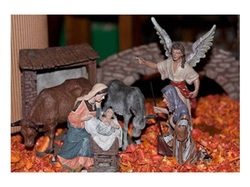
Christmas Santons-Wikimedia Commons
by Kathy Warnes
Christmas santons and the World War II Stars and Stripes newspaper staff writer Paul S. Green bring an enduring message of peace from the Second World War.
The Monday, December 25, 1944, Christmas edition of the Stars and Stripes, the American Armed Forces newspaper, featured a story by staff writer, Paul S. Green. Staff writer Green wrote about Christmas in Marseilles, the chief city of Provence in France. In his story, staff writer Green said that Christmas in Provence was different than in any other province in France because of the ancient tradition in Provence of reproducing miniature versions of the crèche, the manager where the infant Jesus was born. Provencals called these miniature versions of the crèche santons, from the Provencal “santouon,” or little saints. The Italian word for santon is “santoni”, a shortened version of “Santi Belli” for beautiful saints.
St. Francis of Assisi Recreates the Manger Scene Even though Paul Green wrote his story about santons 66 years ago, the ancient custom of santons traces back to thirteenth century Grecio, Italy, where St. Francis of Assisi first created a crude stable to recreate the birth of Christ. He laid moss and straw in his recreated stable to mimic the stable of Bethlehem. He fashioned figures of Jesus, the Virgin Mary, and St. Joseph. He created villagers who traveled on donkeys and oxen from far and wide to visit the miracle at the stable.
Italian migrants crossing the border into Provence, then the closest province to Italy, brought the colorful santons custom with them and santons soon became a central part of the Provencal Christmas. Paul Green wrote that santons were so prevalent that Christmas trees were seldom found in Provencal homes. Crèches replaced Christmas trees, although the crèche custom didn’t spread to other parts of France.
Provencal Citizens are Mirrored in Santons
Santons are figurines of Provencal citizens on their way to celebrate the birth of Jesus with their humble, local offerings. These citizens include the scissors grinder, the fishwife, the blind man, and the chestnut seller. They are usually dressed in nineteenth century style although their origins trace back to thirteenth century.
In addition, santons include the three wise kings who along with the shepherds visit Joseph, Mary and the baby Jesus. Besides the Christmas scene, crèches often illustrate typical Provencal villages. A maker of santons is called a santionnier, and skilled santionniers passed their knowledge down from parents to children for centuries.
There are two types of santons, santons d'argile or clay figures and santons habille or clothed figures that resemble dolls. The earlier bas-relief santons evolved into carved wooden figures that included marionettes, clockwork characters and even children in costumes in living creches.
Provencal santons are made from the fine clay or argile that is found around Marseilles and Aubagne. The santionniers make two piece plaster molds from original carvings and fill them with the clay for molding. They take the figure from the mold to paint it before it is dried and baked. The santionniers hand paint the figures with great care, using bright colors.
Santons were air dried instead of fired in a kiln until the end of the nineteenth century, and the air dried figurines were fragile and easily broken. Santons made in the twentieth and twenty-first centuries are usually fired in a kiln.
Jean-Louis Lagnel Makes Santons During the French Revolution The churches were closed during the French Revolution, depriving people of santon creative and religious expression and destroying markets for the crèche makers. Ordinary people set up crèches in their homes, something that had previously been a custom for rich people. These crèches or santons became increasingly elaborate.
Jean-Louis Lagnel of Marseilles had made molded figurines for the church crèches and when the churches were closed he decided to make santons for the entire population at affordable prices. He made small clay figurines in plaster molds and dried them before firing them. His santons became instantly successful and inspired an industry.
People in Marseilles started a santon fair, another sprang up at Aubagne to the east, and soon there were santon fairs at villages throughout Provence. Since 1803, santonniers have gathered each December in Marseilles to sell their santons and Aubagne holds a two day fair.
The Musee du Santon in Marseilles exhibits a private collection of eighteen and nineteenth century santons. Several towns and villages in Provence present elaborate creches or santons festivals in November and December.
Paul Green Describes World War II Santons In his 1944 Christmas story in the Stars and Stripes, Paul Green reported that during Christmastime the stalls along La Canabere in Marseilles and dozens of stores were filled with santons of all sizes, all types, and all prices. The most popular were figures of Jesus on a bed of straw, the Virgin Mary, St. Joseph, the ox, the donkey, and the lamb. Among the other favored santons were the Three Kings, the simple minded peasant, the female washerwoman, the fishmonger, the knife grinder, the gypsy, the baker, the blind man, the drummer, the woodcutter, the fisherman, the tailor, the hunter, the carpenter, the forester, and the peasant riding a donkey.
The Prayer that the Children Prayed in Front of the Santons According to Paul Green’s story, on Christmas Eve the children put their shoes under the chimney instead of hanging up their stockings as Americans did and according to tradition they said the following prayer in front of the santons:
“Faithful to the crèche, Lord, bestow upon us the virtues of those who surround thee and of the products which they offer thee.
Make us philosophical as the fisherman, untroubled as the drummer, joyous as the simple peasant, hard working as the washerwoman, patient as the spinner, valiant as the donkey, strong as the ox.
Give us the sacred leisure time of the hunter, give us also the tastes of the shepherd, the pride of work of the knife grinder and the thinker, the songs of the miller.
Give us the wisdom of the Magi.
Give us the cheerfulness of the dove, the petulance of the cock, the prudence of the snail, the gentleness of the lamb.
Give us the goodness of bread, the tenderness of soft cookies, the piquancy of the cod fish, the good humor of heated wine, and the relish of garlic.
Give us the purity of oil.
Amen”
Paul Green wrote that Christmas in Provence as in America, is a holiday of the home and families gather around the festive board to eat, drink, and be merry. He said that “The Provencal who is a big eater normally, outdoes himself at Christmas, but this year many will be satisfied with spam (the edible kind) in the American tradition.”
Santon Prayer of Peace During World War II Fits Our Twenty-first Century World War II disturbed Christmas celebrations in Provence as well as the rest of the world. The Christmas of 1944, the first since the liberation, Provencals sang with more than usual fervor the ancient Christmas hymn:
“To you father and mother, /I wish a happy holiday, /Peace..no more war…health…good appetite, /The angels on this very day/Are everywhere on earth, /Let there be peace,/No more war/We will never tire of praying,/No more war. Let there be peace.”
References
“Marseilles Christmas Not Typically French,” Paul S. Green. Stars and Stripes, December 25, 1944
Christofferson, Thomas and Christofferson, Michael. France During World War II: From Defeat to Liberation (World War II: the Global, Human, and Ethnical Dimension) Fordham University Press, 2006
Jackson, Julian. France: The Dark Years, 1940-1944. Oxford University Press, 2007.
Paxton, Robert D. Vichy France: Old Guard and New Order, 1940-1944. Columbia University Press, 2001
Riding, Alan. And the Show Went On: Cultural Life in Nazi Occupied Paris. Knopf, 2010
Vinen, Richard. The Unfree French: Life Under the Occupation. Yale University Press, 2007
Christmas santons and the World War II Stars and Stripes newspaper staff writer Paul S. Green bring an enduring message of peace from the Second World War.
The Monday, December 25, 1944, Christmas edition of the Stars and Stripes, the American Armed Forces newspaper, featured a story by staff writer, Paul S. Green. Staff writer Green wrote about Christmas in Marseilles, the chief city of Provence in France. In his story, staff writer Green said that Christmas in Provence was different than in any other province in France because of the ancient tradition in Provence of reproducing miniature versions of the crèche, the manager where the infant Jesus was born. Provencals called these miniature versions of the crèche santons, from the Provencal “santouon,” or little saints. The Italian word for santon is “santoni”, a shortened version of “Santi Belli” for beautiful saints.
St. Francis of Assisi Recreates the Manger Scene Even though Paul Green wrote his story about santons 66 years ago, the ancient custom of santons traces back to thirteenth century Grecio, Italy, where St. Francis of Assisi first created a crude stable to recreate the birth of Christ. He laid moss and straw in his recreated stable to mimic the stable of Bethlehem. He fashioned figures of Jesus, the Virgin Mary, and St. Joseph. He created villagers who traveled on donkeys and oxen from far and wide to visit the miracle at the stable.
Italian migrants crossing the border into Provence, then the closest province to Italy, brought the colorful santons custom with them and santons soon became a central part of the Provencal Christmas. Paul Green wrote that santons were so prevalent that Christmas trees were seldom found in Provencal homes. Crèches replaced Christmas trees, although the crèche custom didn’t spread to other parts of France.
Provencal Citizens are Mirrored in Santons
Santons are figurines of Provencal citizens on their way to celebrate the birth of Jesus with their humble, local offerings. These citizens include the scissors grinder, the fishwife, the blind man, and the chestnut seller. They are usually dressed in nineteenth century style although their origins trace back to thirteenth century.
In addition, santons include the three wise kings who along with the shepherds visit Joseph, Mary and the baby Jesus. Besides the Christmas scene, crèches often illustrate typical Provencal villages. A maker of santons is called a santionnier, and skilled santionniers passed their knowledge down from parents to children for centuries.
There are two types of santons, santons d'argile or clay figures and santons habille or clothed figures that resemble dolls. The earlier bas-relief santons evolved into carved wooden figures that included marionettes, clockwork characters and even children in costumes in living creches.
Provencal santons are made from the fine clay or argile that is found around Marseilles and Aubagne. The santionniers make two piece plaster molds from original carvings and fill them with the clay for molding. They take the figure from the mold to paint it before it is dried and baked. The santionniers hand paint the figures with great care, using bright colors.
Santons were air dried instead of fired in a kiln until the end of the nineteenth century, and the air dried figurines were fragile and easily broken. Santons made in the twentieth and twenty-first centuries are usually fired in a kiln.
Jean-Louis Lagnel Makes Santons During the French Revolution The churches were closed during the French Revolution, depriving people of santon creative and religious expression and destroying markets for the crèche makers. Ordinary people set up crèches in their homes, something that had previously been a custom for rich people. These crèches or santons became increasingly elaborate.
Jean-Louis Lagnel of Marseilles had made molded figurines for the church crèches and when the churches were closed he decided to make santons for the entire population at affordable prices. He made small clay figurines in plaster molds and dried them before firing them. His santons became instantly successful and inspired an industry.
People in Marseilles started a santon fair, another sprang up at Aubagne to the east, and soon there were santon fairs at villages throughout Provence. Since 1803, santonniers have gathered each December in Marseilles to sell their santons and Aubagne holds a two day fair.
The Musee du Santon in Marseilles exhibits a private collection of eighteen and nineteenth century santons. Several towns and villages in Provence present elaborate creches or santons festivals in November and December.
Paul Green Describes World War II Santons In his 1944 Christmas story in the Stars and Stripes, Paul Green reported that during Christmastime the stalls along La Canabere in Marseilles and dozens of stores were filled with santons of all sizes, all types, and all prices. The most popular were figures of Jesus on a bed of straw, the Virgin Mary, St. Joseph, the ox, the donkey, and the lamb. Among the other favored santons were the Three Kings, the simple minded peasant, the female washerwoman, the fishmonger, the knife grinder, the gypsy, the baker, the blind man, the drummer, the woodcutter, the fisherman, the tailor, the hunter, the carpenter, the forester, and the peasant riding a donkey.
The Prayer that the Children Prayed in Front of the Santons According to Paul Green’s story, on Christmas Eve the children put their shoes under the chimney instead of hanging up their stockings as Americans did and according to tradition they said the following prayer in front of the santons:
“Faithful to the crèche, Lord, bestow upon us the virtues of those who surround thee and of the products which they offer thee.
Make us philosophical as the fisherman, untroubled as the drummer, joyous as the simple peasant, hard working as the washerwoman, patient as the spinner, valiant as the donkey, strong as the ox.
Give us the sacred leisure time of the hunter, give us also the tastes of the shepherd, the pride of work of the knife grinder and the thinker, the songs of the miller.
Give us the wisdom of the Magi.
Give us the cheerfulness of the dove, the petulance of the cock, the prudence of the snail, the gentleness of the lamb.
Give us the goodness of bread, the tenderness of soft cookies, the piquancy of the cod fish, the good humor of heated wine, and the relish of garlic.
Give us the purity of oil.
Amen”
Paul Green wrote that Christmas in Provence as in America, is a holiday of the home and families gather around the festive board to eat, drink, and be merry. He said that “The Provencal who is a big eater normally, outdoes himself at Christmas, but this year many will be satisfied with spam (the edible kind) in the American tradition.”
Santon Prayer of Peace During World War II Fits Our Twenty-first Century World War II disturbed Christmas celebrations in Provence as well as the rest of the world. The Christmas of 1944, the first since the liberation, Provencals sang with more than usual fervor the ancient Christmas hymn:
“To you father and mother, /I wish a happy holiday, /Peace..no more war…health…good appetite, /The angels on this very day/Are everywhere on earth, /Let there be peace,/No more war/We will never tire of praying,/No more war. Let there be peace.”
References
“Marseilles Christmas Not Typically French,” Paul S. Green. Stars and Stripes, December 25, 1944
Christofferson, Thomas and Christofferson, Michael. France During World War II: From Defeat to Liberation (World War II: the Global, Human, and Ethnical Dimension) Fordham University Press, 2006
Jackson, Julian. France: The Dark Years, 1940-1944. Oxford University Press, 2007.
Paxton, Robert D. Vichy France: Old Guard and New Order, 1940-1944. Columbia University Press, 2001
Riding, Alan. And the Show Went On: Cultural Life in Nazi Occupied Paris. Knopf, 2010
Vinen, Richard. The Unfree French: Life Under the Occupation. Yale University Press, 2007
