Hans Brinker, The Dutch Hero Who Isn't Really Dutch
by Kathy Warnes
Hans Brinker is an American invention, but the friendly and accommodating Dutch have given him Dutch translations, statues, and cultural and folklore space.
Holland has had its share of floods, since most of it is below sea level. In the Middle Ages, floods came nearly every decade and the Dutch ingeniously and skillfully built a system of dikes to hold back the flood waters. The dikes became legend in other countries, including America.
According to some Dutch people, when Americans visit Holland many of them leave disappointed because no one can show them the dike that Hans Brinker plugged with his finger.
Legend Says that Hans Brinker’s Father was a Sluicer
Many years ago a fine young boy, supposedly named Hans Brinker, lived in Haarlem, one of the principal cities of Holland. His father was a sluicer, a man who opened and closed the large oaken gates that were regularly spaced across canal entrances to regulate the amount of water flowing into them.
One autumn afternoon eight year old Hans set off to visit a friend who lived out in the country on the other side of the dike. Trudging along the canal on his way home, Hans heard the sound of trickling water. He looked up and saw a small hole in the dike and watched a tiny stream of water flowing out of it. Quickly Hans inserted his chubby finger in the hole and the flow of water stopped.
All night he plugged the hole in the dike, numb with cold and fear. At daybreak, a clergyman returning from the bedside of a sick parishioner, walked along the top of the dike. Thinking that he heard someone groaning he peered over the edge and far down the side he saw Hans squirming with pain. The clergyman quickly summoned help. Hans had prevented a disastrous flood.
The story of the boy whose name was supposedly Hans and his heroism is inspiring, but it happened in a novel written by an American author.
Mary Mapes Dodge Creates Hans Brinker
Mary Elizabeth Mapes Dodge was born in New York in 1831. In 1859 she began writing and editing, and in 1865, she published Hans Brinker, or the Silver Skates which became an instant best seller.Hans Brinker, or the Silver Skates, contains much Dutch cultural and historical information because Mary Mapes Dodge carefully researched Holland. She also received much firsthand information about Dutch life from the Scharffs, her immigrant Dutch neighbors, but she never visited Holland until after her novel was published. Hans Brinker, or the Silver Skates, has been continuously in print since 1865, in multiple editions and formats. It is a children’s classic.
The Story of Hans Brinker- The Mary Mapes Dodge Version
The story of Hans Brinker revolves around a beautiful pair of silverskates. Hans, 15, and his younger sister Gretel wanted to enter the ice skating race on the canal, but all they have is homemade wooden skates. Hans’s father fell from the dike where he worked as a sluicer, and he is so severely inbjured that he cannot work. Mrs. Brinker, Hans, and Gretel have to work to survive and life is a struggle.
Hans and Gretel discover that Dr. Boekman, a famous surgeon, is qualified to help their father but they don’t have the money for his fee and he is gruff and unapproachable because of a personal tragedy. Eventually, Dr. Boekman examines Mr. Brinker and he says that Mr. Brinker can be cured by an expensive and risky operation.
Hans has saved his money to buy steel skates for the race, but he offers it to Dr. Boekman for his father’s operation. Touched, Dr. Boekman operates for free and Hans buys good skates for the race. He could win the race, but allows a friend with more pressing needs to win the silver skates. Mr. Brinker is restored to health and memory and Dr. Boekman loses his gruff ways. Eventually, Dr. Boekman helps Hans go to medical school and Hans becomes a successful doctor.
Novel Introduces Plugging Hole in the Dike Legend
The novel introduced Dutch speed skating to Americans and it also introduced the fictional story of the little Dutch boy who plugged a hole in the dike with his finger.P.J. Andriessen translated the story of Hans Brinker into Dutch in 1867, but the story of Hans Brinker and the dike isn’t present in Dutch oral tradition or cultural awareness. Andriessen always added this sentence:
"This sweet story is entirely the author’s view."
Thinking about the nature of fingers and dikes reveals why the story is a legend. Dutch dikes are not stone dams or walls and real dikes consisting mainly of clay are used against rivers and lakes. A finger in a clay dike won’t help.
The Dutch Provide a Dike and a Hans Brinker
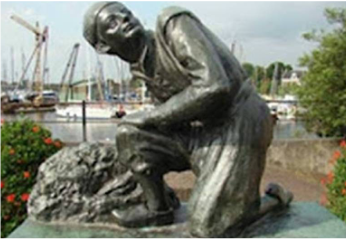
American tourists continued to ask to see the dike and Hans Brinker so insistently that in 1950, the Dutch Bureau for Tourism decided to place a statue of Hans Brinker by the sculptor Grada Rueb at Spaarndam.
In 1954, Dutch author Margreet Bruijn rewrote the old story as Een nieuw verhaal naar het oude boek van Mary Mapes Dodge, illustrated by Maarten Oortwijn. She placed the story in Spaarndam because of the statue which is also known as Hans Brinker. The inscription beneath the statue is in Dutch and English and it reads:
Opgedragen aan onze jeugd als een huldeblijk aan de knaap die het symbool werd van de eeuwigdurende strijd van Nederland tegen het water.
Dedicated to our youth, to honor the boy who symbolizes the perpetual struggle of Holland against the water.
The Dutch tactfully used the word "symbolizes" because the story isn’t a popular folktale in Holland, but thanks to the statue at Spaarndam, American tourists can visit the "Dutch" hero that originated in an American novel.
References
Acciano, R. and Gray, Jeremy, The Netherlands, Lonely Planet Publications, 2004.
Dijkstra, Stephanie, The Holland Handbook, 2004-2005: The Indispensable Reference Guide for the Expatriate, Cyan Communications, 2004.
Dodge, Mary Mapes, Hans Brinker or the Silver Skates, Cosimo Classics, 2005
Meder, Theo, The Flying Dutchman and Other Folktales from the Netherlands-
World Folklore Series, Libraries Unlimited, 2007
Authentic Dutch Mermaid and Flood Folk Tales
Dutch folklore has a treasure trove of mermaid and flood stories that have been passed down through the generations.
The Mermaid of Westenschouwen
This story comes from Westenschouwen, a village in the Dutch province of Zeeland. One day some fishermen from Westenschouwen caught a strange looking creature in their nets. The creature, half human and half fish, and covered with seaweed, cried and cried. The entire day people gathered around her, staring at her in amazement.
When night fell, the people heard a male voice calling from the sea. The male voice shouted that he wanted his wife back, but the fishermen refused to return her. Again and again, the mermaid’s husband came back, and again the fishermen refused to free her. Finally, the mermaid’s husband said:
Westenschouwen,
You will regret
That you have taken my wife.
Westenschouwen
Will drown,
Only the plump church tower will remain.
This is what happened when Westenschouwen vanished under the sea at the end of the fifteenth century.
Another flood and mermaid story comes from the province of North-Holland.
The Edam , Haarlem, and Possibly Catholic Mermaid
At the beginning of the 15th century, which appeared to be a century for mermaid, a fierce storm broke near Edam. A mermaid, covered with seaweed and moss, floated into the Zuiderzee and then she washed into Lake Purmer though a large hole in the dike. She floated around from one bank of the lake to the other, sleeping and waking. She found food at the bottom of the lake. In the meantime, the hole in the dike had been closed, so the mermaid couldn’t reach the sea again.
Women and girls sailed small boats from Edam and other places to the other side of the lake to milk cows. The women and girls saw the mermaid and at first, the mermaid frightened them. After they had frequently seen the mermaid, they summoned the courage to surround her with their boats. They pulled her out of the water and took her to Edam.
In Edam, no one could understand the mermaid’s language and she didn’t understand them either. The people took away her seaweed and moss gave her human clothes to wear. She also ate human food. The people had to guard her well, because she frequently tried to jump into the water.
Before the Purmer Gate in Edam was demolished in 1835, a statue of a mermaid stood by it. The words on the statue said: This statue was erected in memory of what had been caught in Lake Purmer in the year 1403.
A lot of people came to look at the mermaid and soon she was so famous that the people of Haarlem wanted to have her. The people of Edam presented the mermaid to the city of Haarlem as a gift. While she lived in Haarlem she learned to spin.
For a long time she lived in Het Gat in the Grote Houtstraat. When she died she was buried at the churchyard, because she often made the sign of the cross as if she had been a good Catholic.
This is a Dutch folktale from the province of South-Holland that tells a flood story.
Children’s Dike – Kinderdijk or the Cat’s on the Cradle
The story happened during the Saint Elisabeth’s Flood on November 18, 1421. The waves surged across the lowlands and dikes everywhere washed away. People and cattle drowned and cries of despair echoed all over the land.
The sea roamed relentlessly, despite the cries of despair. The water ran through the huge holes in the dikes and grabbed everything it touched. More than 72 villages near the city of Dordrecht drowned. The sea swallowed houses and churches and people and cattle.
The sea converted fertile soil into a vast stretch of salt water and transformed the land that had once sheltered busy shops and homes into the Biesbosch .The Biesbosch is a large network of rivers and smaller and larger creeks with islands. Willow forests make up most of the vegetation in the Biesbosch, but there are also wet grasslands and fields of reeds. The Biesbosch is an important wetland area for waterfowl and has rich flora and fauna.
Other than the Biesbosch, one other miracle happened. One human life remained. A tiny speck, a dot bobbed on the surface of the flood waters as the waves gently rocked it. The tiny speck turned out to be a cradle containing a tiny, rosy baby boy. The baby boy sucked his thumb and stared up innocently at the grey sky. His blue eyes reflected the sunshine that came out after the storm.
The cradle didn’t turn over and the waves didn’t wash it away because a cat stood on the hood of the cradle. The cat jumped from left to right and back again, keeping the cradle in balance.
The place where the baby boy came ashore is called Kinderdijk or Childrensdyke.
The fall of Tidde Winnenga
In the Middle Ages, the farmers of Reiderland were the richest farmers of Groningen and Tidde Winnenga was the richest of them all. One day a severe storm brewed and everyone worked to strengthen the dike except Tidde Winnenga. His neighbors begged him to help because the entire land was in great danger. He wasn’t worried because his farm stood on higher ground. Tidde Winnenga said he wouldn’t leave his farm until the water on his land reached six feet high.
The dike broke and the sea washed away the entire Reiderland, creating the Dollard. The Dollard is an area consisting of mud flats, sandbanks, channels and salt marshes on the edges.
While the sea created the Dollard it flooded much of Reiderland. In the middle of the night a man knocked at the door of the Palmar monastery which had not been flooded. The man, a tall, bowed figure asked for permanent bread and shelter. Tidde Winnenga was the man and he had lost everything he owned. They made room for him at the convent, and they gave him food and lodging for the rest of his life.
According to folklorist Theo Meder, Tidde Winnenga is the story of Hans Brinker reversed. Meder says that Dutch people don’t like heroes that much except when they play soccer!
Theo Meder
Meertens Instituut, Amsterdam
