WINDOWS TO WORLD HISTORY
  • Home
  • Bishop Walter Hawkins: Protected by the British Lion
  • World History Windows
  • The White Roses Defy the Nazis
  • Elias Lonnrot Compiles the Kalevala
  • Because You Were Here We Are Enriched
  • Provocative People
    • Stephane Hessel Wrote Indignez Vous
    • Writer Lafcadio Hearn Merged Greek and Japanese Cultures
    • Are Paul Redfern and the Port of New Brunswick Buried in the Amazon Jungle?
    • Hans Brinker, the Dutch Hero Who Isn't Really Dutch!
    • Rudolf Vrba and Alfred Wetzler Fled Auschwitz and Wrote a Report
    • Roman Emperor Caligula and His Legendary Lake Nemi Ships
    • Rabbi Robert Serebrenik Defies Adolf Eichmann to Save Luxembourg Jews
    • The Confederados Become Brazilian, but Honor Their Southern Roots
    • Pliny the Younger Wrote Letters about His Life in Ancient Rome
    • Hannes Hafstein, Iceland's Poet-Prime Minister, Works for a Cable
    • Mermen Are Important Players in Scandinavian Culture and History
    • William Tell, Mythical Hero, Mythical Historical Figure, or Both?
    • Fritz Thyssen Helped Finance the Nazi Party, but Later Changed His Mind
    • Leif Ericson and L'Anse Meadows
    • Sigrid and Eirikr Magnusson Contributed Much to Iceland's Culture
    • Clara and Henry Leffingwell - An English, Australian, and American Story
    • Per Jacobsen, Norwegian Ice Skater and Resistance Fighter
    • Poul La Cour Pioneered Wind Power in Denmark
    • Michel Linovich- an Italian in Napoleon's Grand Army
    • Solomon Linda, the Lion Sleeps Tonight
    • Sergei Rachmaninoff Composed Rhapsody at Senar, His Swiss Villa
  • Raoul Wallenberg, the Hero Who Never Returned to Sweden
  • Jean Baptiste Sipido Tries to Assassinate the Prince of Wales
  • The Legend of the Hermit of Cape Maleus in Greece Transcends Time
  • Happy Hands-On Historical New Year!
  • Christmas Around the World
    • A Christmas Tribute to Captain Henry Waskow
    • European Christmases in Centuries Past
    • Chasing and Capturing the Fugitive Spirit of Father Christmas
  • Women in World History
  • Madam Elisabeth Thible is the First Woman to Ride in a Free Floating Balloon
  • Nurse Edith Cavell Had The Courage to Die for Her Country
  • Gertrud Scholtz-Klink Followed Hitler Her Entire Life
  • Suzanne Valadon and Maurice Utrillo - Artists of Montmartre
  • SOE Agent Andree Borrel Lived Several Lifetimes in Her 24 Years
  • Queen Alexandra of Great Britain - Queen Victoria's Daughter-in-Law, Bertie's Patient Wife, and Her Own Person
  • Maria Gulovich Liu Joined the Czech Resistance, Won the Bronze Star and became an American Citizen
  • Francoise Marie Jacquelin, Lioness of Latour, Lioness of Acadia, Woman in her Own Right
  • Grand Duchess Marie Adelaide of Luxembourg is a Symbol of Effective Rule
  • Clara Zetin Speaks Against Hitler in the German Reichstag
  • Madam Sophie Blanchard - Official Aeronaut of the Restoration
  • Queen Amelia Maria, the Last Queen of Portugal, Stood Her Ground
  • Places for Posterity
  • Haunted Church Bells Ring in Boscastle and Tintagel in Cornwall
  • Vienna Plague Defenses Included Plague Hospitals
  • The Plundering Plague and the Downfall of the Republic of Venice
  • Ostend Belgium
  • Centuries of History and Ghosts Haunt Denmark's Dragsholm Castle
  • Does Jacques LeRay Chaumont Still Haunt Chaumont Castle?
  • Soldier's Stories
  • Napoleon Bonaparte Ignores His Little Red Man of Destiny
    • The French Revolution Has More Phases than the Moon!
    • Napoleon Bonaparte Still Owes Innkeeper Hippolyte Baretta Sixty Francs!
    • Australian War Correspondent Alan Moorehead Returns to His Roots
    • General Christian Christensen is a Dual Citizen of Denmark and the United States
    • In 1919, Villagers and Soldiers Helped Rebuild Chateau-Thierry
    • The Dudman Family Lived the Meaning of Patriotism and Sacrifice During World War II
    • Five French Boys Canoe the English Channel
    • Stalin's Spin Doctors
    • Maurice Maeterlinck Encounters American Customs
    • Carl von Ossietzky Wins the Nobel Prize While in a Nazi Prison Camp
    • Flying Kites Through All Seasons, Countries, and Histories
  • World History 101
    • Pieces of World- History Puzzle
    • World History Puzzles - the Old World Meets the New World

Carl von Ossietzky Wins a Nobel Prize While in a Nazi Prison Camp
Picture


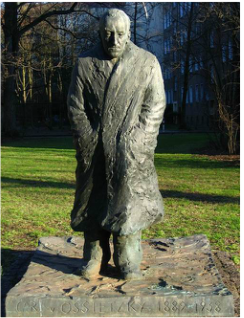
In 1935, Carl von Ossietzky was a prisoner in the Papenburg-Esterwegen Concentration Camp , but he won the Nobel Peace Prize and exposed the Nazi war machine

Although his father, a civil servant, originally came from a village near the German-Polish border, Carl von Ossietzky was born in Hamburg, Germany, on October 3, 1889. Carl’s father Carl Ignatius von Ossietzky worked as a stenographer in the office of a lawyer and senator. His mother Rosalie was a devout Catholic who wanted Carl to become a monk. In 1891, seven years after his father died, Carl’s mother married Gustav Walther, a Social Democrat who shaped Carl’s political ideals.

Since Carl achieved only a checkered academic career, he left school at age 17 to take a job as an administrative civil servant in Hamburg. Soon, he found journalism more to his liking and his first work appeared in The Free People- the weekly newspaper of the Democratic Union. On July 5, 1913, an article  that he had written criticizing a pro military court decision in Erfurt caught the attention of the Prussian War Ministry. The War Ministry charged Carl with “insult to the common good” and ordered him to make a court appearance. Carl had married Maud Woods, an Englishwoman, on May 22, 1914, and his new wife secretly arranged to pay his fine. Carl fought briefly in World War I, and returned a firm pacifist.

Carl von Ossietzky Works for Democracy During the Weimer Republic Years

During the Weimar Republic years, 1919-1933, Carl Ossietzky’s political commentaries and newspaper writing established him as a fervent supporter of democracy and peace. In 1926, Siegfried Jacobsohn, founder and editor of The World Stage, offered him a position on his editorial staff. Jacobsohn had become involved in uncovering and publicizing the secret rearmament of Germany and when he died unexpectedly in December 1926, his widow named Carl editor in chief of the newspaper.

Over the next two years Carl published articles exposing the secret German rearmament violating the Treaty of Versailles and revealing that Germany was building an airforce in collaboration with the Soviet Union. In August 1929, the German Government charged Carl Ossietzky with betrayal of military secrets,  although German rearmament had been previously documented. He was tried in November 1931, found guilty, and sentenced to 18 months in Spandau Prison. After seven months in prison, he was released in the Christmas amnesty of 1932.


Carl von Ossietzky Fights the Nazis

By early 1933, von Ossietzky, with a clearer vision than his newspaper colleagues, realized that the Nazis were poised for a take over, but he refused to leave Germany, remarking that “a man speaks with a hollow voice from across the border.”

When Adolf Hitler assumed power in 1933, the Nazis controlled less than three percent of Germany’s 4,700 papers. In the following months, the Nazis took over the independent press and put the political measures in place that eradicated civil liberties and democracy. Nazis broke into opposing political party offices, destroying printing presses and newspapers. The Propaganda Ministry took control of the Reich Association of the German Press, and set out to control the content of news and editorial pages.

Fearing imprisonment or death, reputable journalists fled Germany in large numbers. Carl stayed and continued to speak out against the Nazis as he had always done. The morning after the Reichstag fire of February 28, 1933, the German secret police arrested Carl Ossietzky at his home and took him to a Spandau Prison. Carl consistently refused to repudiate his earlier pacifist work in return for freedom. Later the police moved him to the concentration camp at Sonnenburg and then to Esterwegen-Papenburg Concentration Camp near Oldenburg. According to reports from his fellow prisoners, Carl was mistreated and forced to perform heavy labor despite the fact that he had already had a heart attack.

Carl von Ossietzky Wins the Nobel Peace Prize

In 1934, Berthod Jacob, one of Carl’s colleagues, suggested that he be nominated for the Nobel Peace Prize. His colleagues in the German League for Human Rights and Hellmut von Gerlach, a former associate on the World Stage, nominated Carl for the Nobel Peace Prize. Organizations and famous people in many parts of the world conducted a letter writing campaign for Carl Ossietzky to receive the Nobel Peace Prize. It took a year for the Nobel Committee to summon the courage to award Carl the prize.

Awarding the Peace Prize to Carl was an extremely controversial move, motivating two members of the prize committee to resign. King Haakon VII of Norway boycotted the ceremony, and the award divided public opinion. Conservative forces generally condemned it. The leading conservative Norwegian newspaper Aftenposten argued editorially that Carl Ossietzky was a criminal who had attacked his country “with the use of methods that violated the law long before Hitler came into power” and that “lasting peace between peoples and nations can only be achieved by respecting the existing laws.”

The Nazi regime put heavy pressure on the Nobel Committee not to award Carl von Ossietzky the prize and it pressured him not to accept it. The German press was forbidden to comment on the granting of the prize to Carl, and the German government decreed that in the future no German could accept any Nobel Prize. The German Propaganda Ministry declared that Carl could go to Norway to accept the prize, but secret police documents later indicated that the government refused Carl a passport.

Carl von Ossietzky himself issued a note from the hospital saying that he disagreed with the authorities who said that by accepting the prize he would cast himself outside the community of German people. He said:

After much consideration, I have made the decision to accept the Nobel Peace Prize which has fallen to me. I cannot share the view put forward to me by the representatives of the Secret State Police that in doing so I exclude myself from German society. The Nobel Peace Prize is not a sign of an internal political struggle, but of understanding between peoples. As a recipient of the prize, I will do my best to encourage this understanding and as a German I will always bear in mind Germany's justifiable interests in Europe.

In May 1936, the Nazi regime sent Carl von Ossietzky to the Westend Hospital in Berlin-Charlottenburg to treat his tuberculosis, but kept him under Gestapo surveillance. Carl Ossietzky’s last public appearance was at a short court hearing where his lawyer was sentenced to two years at hard labor for embezzling most of Ossietzky’s prize money.

On May 4, 1938, still in police custody, he died in the Nordend Hospital in Berlin- officially from tuberculosis. Privately his friends agreed that the effects of the abuse he had suffered in the concentration camps also hastened his death.

Carl von Ossietzky Is Remembered

In 1991, the University of Oldenburg was renamed Carl von Ossietzky Universitat Oldenburg in his honor and in 1995 an eight volume German edition of his collected writings was published. Carl von Ossietzky’s daughter Rosalinde von Ossietzky-Palm worked for years to overturn his conviction by the German courts, but in 1992 the German Federal Court of Justice upheld the verdict of the earlier courts.

References

Abrams, Irwin. “Carl von Ossietzky Retrospective,” in Nobel Prize Annual 1989. Boston: G.K. Hall, 1990

Bytwerk, Randall L. Bending Spines: The Propaganda of Nazi Germany and the German Democratic Republic (Rhetoric and Public Affairs Series) Michigan State University Press, 2004

Deak, Istvan. Weimer Germany’s Left Wing Intellectuals. Berkeley: University of California Press, 1968

Grossman, Kurt. Ossietzky: A German Patriot. Munich

Leber, Annedore, ed. Conscience in Revolt. Translated by Rosemary O’Neill. Westport, Conn. Associated Booksellers, 1957

Nathan, Otto and Heinz, Nordan, eds. Einstein on Peace: New York: Simon & Schuster, 1960

Ossietzky, Carl von. The Stolen Republic: Selected Writings of Carl von Ossietzky. Translated by John Peet. London: Lawrence 7 Wishart, 1971

Suhr, Elke. Carl von Ossietzky: A biography. Cologne: Kiepenheuer & Witsch 1988



Powered by Create your own unique website with customizable templates.
  • Home
  • Bishop Walter Hawkins: Protected by the British Lion
  • World History Windows
  • The White Roses Defy the Nazis
  • Elias Lonnrot Compiles the Kalevala
  • Because You Were Here We Are Enriched
  • Provocative People
    • Stephane Hessel Wrote Indignez Vous
    • Writer Lafcadio Hearn Merged Greek and Japanese Cultures
    • Are Paul Redfern and the Port of New Brunswick Buried in the Amazon Jungle?
    • Hans Brinker, the Dutch Hero Who Isn't Really Dutch!
    • Rudolf Vrba and Alfred Wetzler Fled Auschwitz and Wrote a Report
    • Roman Emperor Caligula and His Legendary Lake Nemi Ships
    • Rabbi Robert Serebrenik Defies Adolf Eichmann to Save Luxembourg Jews
    • The Confederados Become Brazilian, but Honor Their Southern Roots
    • Pliny the Younger Wrote Letters about His Life in Ancient Rome
    • Hannes Hafstein, Iceland's Poet-Prime Minister, Works for a Cable
    • Mermen Are Important Players in Scandinavian Culture and History
    • William Tell, Mythical Hero, Mythical Historical Figure, or Both?
    • Fritz Thyssen Helped Finance the Nazi Party, but Later Changed His Mind
    • Leif Ericson and L'Anse Meadows
    • Sigrid and Eirikr Magnusson Contributed Much to Iceland's Culture
    • Clara and Henry Leffingwell - An English, Australian, and American Story
    • Per Jacobsen, Norwegian Ice Skater and Resistance Fighter
    • Poul La Cour Pioneered Wind Power in Denmark
    • Michel Linovich- an Italian in Napoleon's Grand Army
    • Solomon Linda, the Lion Sleeps Tonight
    • Sergei Rachmaninoff Composed Rhapsody at Senar, His Swiss Villa
  • Raoul Wallenberg, the Hero Who Never Returned to Sweden
  • Jean Baptiste Sipido Tries to Assassinate the Prince of Wales
  • The Legend of the Hermit of Cape Maleus in Greece Transcends Time
  • Happy Hands-On Historical New Year!
  • Christmas Around the World
    • A Christmas Tribute to Captain Henry Waskow
    • European Christmases in Centuries Past
    • Chasing and Capturing the Fugitive Spirit of Father Christmas
  • Women in World History
  • Madam Elisabeth Thible is the First Woman to Ride in a Free Floating Balloon
  • Nurse Edith Cavell Had The Courage to Die for Her Country
  • Gertrud Scholtz-Klink Followed Hitler Her Entire Life
  • Suzanne Valadon and Maurice Utrillo - Artists of Montmartre
  • SOE Agent Andree Borrel Lived Several Lifetimes in Her 24 Years
  • Queen Alexandra of Great Britain - Queen Victoria's Daughter-in-Law, Bertie's Patient Wife, and Her Own Person
  • Maria Gulovich Liu Joined the Czech Resistance, Won the Bronze Star and became an American Citizen
  • Francoise Marie Jacquelin, Lioness of Latour, Lioness of Acadia, Woman in her Own Right
  • Grand Duchess Marie Adelaide of Luxembourg is a Symbol of Effective Rule
  • Clara Zetin Speaks Against Hitler in the German Reichstag
  • Madam Sophie Blanchard - Official Aeronaut of the Restoration
  • Queen Amelia Maria, the Last Queen of Portugal, Stood Her Ground
  • Places for Posterity
  • Haunted Church Bells Ring in Boscastle and Tintagel in Cornwall
  • Vienna Plague Defenses Included Plague Hospitals
  • The Plundering Plague and the Downfall of the Republic of Venice
  • Ostend Belgium
  • Centuries of History and Ghosts Haunt Denmark's Dragsholm Castle
  • Does Jacques LeRay Chaumont Still Haunt Chaumont Castle?
  • Soldier's Stories
  • Napoleon Bonaparte Ignores His Little Red Man of Destiny
    • The French Revolution Has More Phases than the Moon!
    • Napoleon Bonaparte Still Owes Innkeeper Hippolyte Baretta Sixty Francs!
    • Australian War Correspondent Alan Moorehead Returns to His Roots
    • General Christian Christensen is a Dual Citizen of Denmark and the United States
    • In 1919, Villagers and Soldiers Helped Rebuild Chateau-Thierry
    • The Dudman Family Lived the Meaning of Patriotism and Sacrifice During World War II
    • Five French Boys Canoe the English Channel
    • Stalin's Spin Doctors
    • Maurice Maeterlinck Encounters American Customs
    • Carl von Ossietzky Wins the Nobel Prize While in a Nazi Prison Camp
    • Flying Kites Through All Seasons, Countries, and Histories
  • World History 101
    • Pieces of World- History Puzzle
    • World History Puzzles - the Old World Meets the New World