Stephane Hessel Wrote Indignez Vous
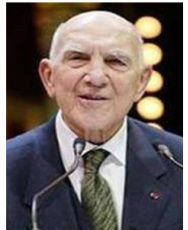
Stephane Hessel- French Archives
By Kathy Warnes
French activist Stephane Hessel survived the Holocaust and World War II and turned his experiences into activism to help the modern world survive itself.
"I would like everyone – every one of us – to find his or her own reason to cry out. That is a precious gift. When something makes you want to cry out, as I cried out against Nazism, you become a militant, tough and committed. You become part of the great stream of history ... and this stream leads us towards more justice and more freedom but not the uncontrolled freedom of the fox in the hen-house." Stephane Hessel- Indignez vous!
By the time he reached age 93 , Stephane Hessel had endured and survived much. He survived world reshaping events like the Holocaust, the French Resistance and World War II. He is the last survivor of the delegates, including Eleanor Roosevelt, who drafted the Universal Declaration of Human rights. the 29 page pamphlet/book that he wrote is surviving the cutthroat Twenty-first Century publishing industry at number one on the best seller list in France and his publishers are negotiating contracts and translations in the rest of Europe and the United States.
Jean-Pierre Barou, co-director the small Montpellier publishing house Indigène, that commissioned Indignez vous! said that Stephane Hessel has uncovered a "deep sense of indignation in France.”
Stephane Hessel’s Book Indignez Vous is Controversial
Stephane Hessel opens his book with his age. “93 years old. It’s a little bit the final phase.” His book which contains 13 pages of text and 16 pages of blurbs and notes came out in October, 2010, with an original print run of 8,000 and a $3.90 price tag. In three months it sold 600,000 copies and Indigine has printed another 200,000 copies. Indignez vous! has sold eight more times the copies of the second book on the bestseller list, a Goncourt prize-winning novel by Michel Houellebecq.
In Indignez vous!, Hessel urges French youth and presumably the rest of his readers to recapture the wartime spirit of resistance to the Nazis by rejecting the “Insolent, selfish,” power of money and markets and by defending “the social values of modern democracy.”
On page 11 of his book, he writes, ‘”the basic reason for resistance was the indignation. We the veterans of that movement, we ask the young generations to relive the same ideals.” He urges people to consider the widening gap between the very rich and very poor, and the dictatorship of capitalism and the market.
Hessel deliberately doesn’t analyze or give solutions to the world’s problems; instead he wants to resurrect the spirit that empowered the French Resistance against the Nazis. He says, “I am not giving them a meaning, but I am saying ‘do try to find for you what would be meaning.”
The book is controversial because it contains a lengthy denunciation of Israeli government policies, especially in the Gaza Strip. The final chapter calls vaguely for a "non-violent" solution to the problems of the world, but it suggests that nonviolence will not bring peace of the Middle East.
Hessel, who is a Socialist, feels that his message has struck a national and international nerve at a time of market and banker tyranny and budget threats to the survival of states and nations. He and his publishers suggest that Indignez vous! could be an important litmus test of the French political cycle leading up to the presidential elections in May of 2012.
The French diplomat said in a New Year’s message that the success of his book “profoundly touched him and just as he cried out against Nazism in the 1940s, people today should cry out against the complicity between politicians and economic and financial powers and defend our democratic rights acquired over two centuries.”
Stephane Hessel Works in the French Resistance
Stephane Hessel lives in a Paris apartment and Paris, including the Palais de Chaillot, has provided a backdrop for some of the most important scenes of his life. The United Nations General Assembly adopted the Universal Declaration of Human Rights in the Palais de Chaillot on December 10, 1948, and Stephane helped draft the Declaration. A stone commemorates the event and the esplanade is called "the esplanade des droits de l'homme - the esplanade of human rights."
Adolf Hitler was pictured on the front terrace of the Palais de Chaillot during his short tour of Paris in 1940, with the Eiffel Tower in the background, a photograph that became an iconic World War II image.
Stephane Hessel played a vital role in another important part of World War II, the French Resistance. He was born in Berlin in 1917, and immigrated to France with his family when he was seven. In 1941, he joined Charles de Gaulle in London and then went back to France on a mission for the French Resistance. In 1944, the Gestapo captured him and sent him to Buchenwald where he avoided being hanged by exchanging identities with Michel Boitel who was dying of typhus.
After World War II, Stephane Hessel Remains an Activist
After World War II, Stephane Hessel worked at the General Secretariat of the United Nations. Then he worked with various French politicians on the left and was ambassador of his country in various capitals. He participated in the commemoration of the 60th anniversary of the Program of the National Council of Resistance of March 15, 1944, which encouraged younger generations to live by and pass on the legacy of the French Resistance and its ideals of economic, social, and cultural democracy.
In 2003, along with other former comrades, Hessel signed the petition "For a Treaty of a Social Europe." In August 2006, he backed an appeal against the Israeli air-strikes in Lebanon, published in French newspapers on behalf of the French Jewish Union for Peace.
On February 21, 2008, at the Place de la Republique in Paris, Stephane Hessel denounced the French government's failure to comply with Article 25 of the Universal Declaration of Human Rights and called for the Government of the French Republic to make funds available to provide housing for the homeless.
At age 93, he is an Ambassador of France and a best selling author. Stephane Hessel is a survivor of the evil treatment of his fellow man and an example of turning that evil treatment into a force for good.
References
Aubric, Raymond and Aubrac, Lucie. The French Resistance: 1940-1944. Hazan, 1997
Hessel, Stephane. Indignez-vous! Indigene, 2010
Meisler, Stanley. United Nations: The First Fifty Years. Atlantic Monthly Press, 1997
Rougeyron, Andre. Angels For Escape: Inside the French Resistance, 1939-1945. Louisiana State University Press, 1995
One Historian’s View: Indignez-Vous! Reminds Us That Only We Can Save Us From Ourselves
Imagine-by John Lennon
…"Imagine no possessions/ I wonder if you can/ No need for greed or hunger/ A brotherhood of man /Imagine all the people /Sharing all the world
You may say that I'm a dreamer/ But I'm not the only one/ I hope someday you'll join us/ And the world will live as one."
The experience is universal. You stand in the middle of the city park or in front of the monument listening to a speech about death and sacrifice. The name of the war may change from World War II to Korea to Vietnam or Iraq or Afghanistan, but the feelings and the sacrifices are the same. You find yourself standing as Stephane Hessel did many times next to a spot where the Nazis murdered a friend or a fellow member of the resistance. You find yourself standing at Ground Zero in New York City. Other people stand and remember and honor with you. Lost in private memory, you think about the enormous capacities humans have for both good and evil. Someone reads the names of the dead and time breezes ruffle the flags.
You feel indignation at the waste, the senselessness, the cruelty of it all.
Politicians and ideologues enter your remembrance and in a tone and a word change the scenario from memorial to inequality, racism, and the evils of the present day. The ceremonies are over. People filter back to their cars and their normal lives. Indignation fades into ordinary life. As the years pass, time wears away the ragged edges of memory, so the same events with different details are repeated down through the years and generations.
Indignez-vous! Protest or Cry Out! cries to preserve the indignation and the question why should such things be? The success of Stephane Hessel’s book that really isn’t a book but an essay printed in a pamphlet, tells us a lot about the resilience of the human spirit. He called his book Indignez-vous! -Protest or Cry Out!
Although it is number one on the bestseller list in France, some journalists, bloggers and critics have been less than complimentary to Hessel’s book. One called it "19 rambling pages of conversations with a sweet and honorable old man." Other criticisms say that it is poorly written, repetitive, unoriginal, simplistic and short. Other critics say that it contains no deep analysis or memorable writing.
The idea that a call for peace and justice is the meanderings of a "sweet old man" and should be accepted with a condescending smile at his naiveté, and perhaps senility, reveals how deeply cynicsm has eroded Enlightenment Ideas. We need people like Stephane Hessel to remind us that sometimes our survival depends on our capacity for indignation. "I would like everyone – every one of us – to find his or her own reason to cry out. That is a precious gift. When something makes you want to cry out, as I cried out against Nazism, you become a militant, tough and committed. You become part of the great stream of history ... and this stream leads us towards more justice and more freedom but not the uncontrolled freedom of the fox in the hen-house."
Stephane Hessel himself and the model of his life cries out to the anger and fear and uncertainly that people around the world are feeling. His book touches on the financial, political, and spiritual problems of the West and the contempt that some people feel for politics and democracy itself. He touches on the importance of regulation, common action and state investment for the public good, but he leaves his readers to come up with their own solutions and act upon them. He is more of a visionary than a politician.
In a New Year message, Stephane Hessel, who survived the French Resistance and Nazi concentration camps to become a French diplomat said that he is profoundly touched by his book’s success. He added that just as he cried out against Nazism in the 1940s, young people today should "cry out against the complicity between politicians and economic and financial powers and defend out democratic rights acquired over two centuries."
He writes in Indignez-vous! that the present requires organized resistance just as 1940 did. "We, veterans of the resistance …call on young people to revive and pass on the heritage and ideas of the Resistance," he writes. People need to resist the power of money and markets by peaceful means. He leaves it to the intelligence and creativity of people all over the world to put their anger into productive channels to create a better world for everyone.
Hessel says: " It's true that reasons to cry out can seem less obvious today. The world appears too complex. But in this world, there are things we should not tolerate... I say to the young, look around you a little and you will find them. The worst of all attitudes is indifference..."
The only error that in Hessel's quote is that he should have addressed everyone, not just young people, when he said "look around you a little and you will find reasons to cry out. The worst of all attitudes is indifference…"
