Nurse Edith cavell had the courage to die for her country
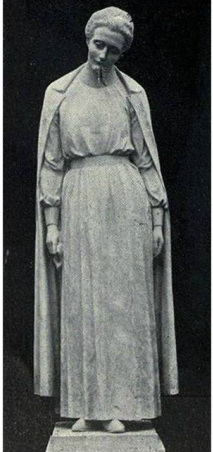
Edith Cavell statue by Hippolyte Lefebvre
Edith Louisa Cavell possessed honest eyes and a transparent soul. These qualities withstood German interrogation, but led to her execution by firing squad. She didn’t fight in the trenches of World War I, but she was a brave soldier who gave her life for her country.
Anglican Vicar Frederick Cavell had strong feelings about many things. He insisted that his last name-Cavell- did not rhyme with hell but gravel, and he insisted on living according to his principles, including thoughts for others, self sacrifice and prayer. He taught all four of his children at the vicarage at Swardeston near Norwich, England, because he couldn’t afford a governess or a private tutor. His daughter Edith, the oldest of his children, eagerly absorbed his principles. As a teenager, Edith attended Miss Margaret Gibson’s school called Laurel Court and became so fluent in French that Miss Gibson recommended her for a governess position to a family in Belgium.
Dr. Depage Recruits Edith Cavell
In 1895, when Edith turned thirty, her father became seriously ill and Edith went home to nurse him. He convinced her that a career in nursing would give her the profession she yearned for, and after he died in 1896, she entered the London Hospital Nurses Training School. Between 1900-1905, she trained as a nurse at the Royal London Hospital and later worked at two London infirmaries.
In October 1907, Dr. Antoine Depage recruited Edith Cavell to become matron of the Berkendael Institute, his new nursing school. It was located on the outskirts of Brussels, Belgium and formed out of four adjoining houses.
By 1910, Edith had firmly established the Institute and nursing as a solid profession in Belgium, and by 1911, she was training nurses for three hospitals, 24 schools, and 13 kindergartens in Belgium. At the beginning of World War I in 1914, the Berkendael Institute supplied many trained nurses for local hospitals and other nursing facilities.
Edith was visiting her mother in Norwich and weeding her mother’s garden when she heard the news that World War I had broken out in Europe. Telling her mother that she would be “..needed more than ever,” she immediately returned to Brussels.
A Messenger From Mons
During September 1914, Herman Capaiu, a young engineer from Mons, came to see Edith. He told her that after the Battle of Mons and the retreat to the Marne, several Allied soldiers had been trapped behind the advancing German front line. In an eerily prophetic statement, he said that the Germans were shooting Allied soldiers and local people who were helping them. Edith began to shelter Allied soldiers at her nursing school.
Word of her sympathy spread. Soon a group of Belgians including Philippe Baucq, an architect in his thirties, based in Brussels, Louise Theuliez of Lille, Louis Severin, apothecary, and Countess Jean de Belleville were working with Edith smuggling Allied soldiers to safety in neutral Holland.
Hiding Allied Soldiers and Violating German Law
The Germans entered Brussels on August 20, 1914, and although Edith Cavell was a citizen of England, an enemy nation, they allowed her to remain Matron of the Berkendael Institute. They also converted the teaching school into a Red Cross Hospital and supervised her work as she started treating injured German soldiers. Edith gave the best treatment she could to soldiers of any nationality.
Food was scarce, but Edith feed the hospital’s expanding list of patients, staff, and escapees. She worked late into the night to avoid prying eyes and questions. By 1915, she sheltered over 200 English and French soldiers.
Prince and Princess De Croy, Belgian aristocrats, masterminded an underground railroad from a chateau in Mons, and with Edith’s guidance, they helped most of the soldiers escape to neutral Holland. Edith’s activities violated German military law, and by this time, German authorities had heard rumors about Edith and began to observe her more closely.
The Germans Arrest Edith Cavell and Philippe Baucq
In early 1915, Gaston Quien arrived on Edith Cavell’s doorstep, claiming to be a French soldier avoiding German authorities. Edith observed that he made a nuisance of himself and insisted that he leave. Quien escaped with a party of soldiers into neutral Holland, but he later returned to the school, claiming that French authorities had ordered him to gather information about German activities in Brussels.
The Germans grew increasingly suspicious about activities at Edith’s hospital and they put it under surveillance. Edith’s friends warned her about the danger surrounding her. She suffered another blow when a German submarine sank the Luisitania and her friend Madame Marie Depage, the wife of the doctor who had started her school, drowned. Still more troubles awaited Edith Cavell.
On Saturday, July 31, 1915, the Germans arrested Phillipe Baucq at his home in Brussels. Louise Thuliez happened to be staying with him and his wife that weekend to arrange safe transportation for some English soldiers and she, too, was arrested. On August 3, 1915, Otto Mayer of the German Secret Police arrested Edith Cavell. She was charged with harboring Allied soldiers and with treason.
Edith Cavell languished in St. Gilles prison for ten weeks, spending the last two in solitary confinement. At her court martial trial she admitted that she had “successfully conducted allied soldiers to the enemy of the German people.” Under German law, her actions were a capital offense and she and Philippe Baucq were sentenced to death in front of a firing squad.
Edith Cavell and Philippe Baucq Are Sentenced to Death
German interrogators tried to penetrate Edith’s calm and measured answers, but still had gotten nowhere after 72 hours of questioning. They decided to trick her. They told Edith that they already had the information they needed and that she could only save her friends from execution by making a full confession. She believed the Germans told them about her activities.
Besides her confession, the only incriminating evidence against Nurse Cavell was a tattered postcard that soldiers had sent from Britain thanking her for rescuing them.The German authorities had arrested 35 people suspected of helping Allied soldiers, and sentenced Edith Cavell and Philippe Baucq to death by firing squad. The American and Spanish ambassadors tried to intervene on Edith’s behalf, citing the impartial and compassionate way that Edith had treated all wounded soldiers.
The British government said it could do nothing to help her. Hugh S. Gibson, First Secretary of the American Legation at Brussels, told the German government that executing Edith Cavell would do more harm to Germany’s already damaged reputation. The German military acted quickly to execute her to deny higher authorities the opportunity to consider clemency
Baron von der Lancken, the German civil governor, said that Edith Cavell should be pardoned because she was completely honest and she had helped save German as well as Allied lives. American minister Brand Whitlock and the Marquis de Villalobar, the Spanish minister to Belgium, spoke on Cavell’s behalf, but Baron Von Der Lancken allowed the execution to proceed on October 12, 1915.
“I Must Have No Hatred Or Bitterness Towards Anyone”
The Germans allowed Anglican Chaplain Reverend Stirling Gahan to come to Edith’s prison cell the night before her execution to give her Holy Communion. According to Reverend Gahan, she said, “Patriotism is not enough. I must have no hatred or bitterness towards anyone.” These words would be inscribed on her statue in St. Martin’s Place, near Trafalgar Square in London. Paul Le Seur, the German Lutheran prison chaplain recorded her final words as: “Ask Father Gahan to tell my loved ones later on that my soul, as I believe, is safe, and that I am glad to die for my country.”
At 6 a.m. on October 12, 1915, Chaplain Le Seur walked the few steps to the pole on the Belgian National Rifle Course with Edith Cavell and the soldiers loosely tied her and put a bandage over her eyes. Sixteen soldiers shot her and Philippe Baucq at a distance of six paces. Later the soldier that covered Edith’s eyes told Chaplain LeSuer that her eyes were full of tears.
After Edith Cavell and Philippe Baucq were executed, soldiers buried them on the rifle range where they were shot and they placed a plain wooden cross over Edith’s grave.
The execution of Edith Cavell turned out to be a major propaganda disaster for the Germans, even though they insisted that the laws of war validated it. The British used her death as an example to encourage men to enlist in the Army, because conscription did not exist in England at this time.
Louise Thuliez Is Condemned with Edith Cavell
On the morning of October 12, 1915, an official announcement from German Goverrnor General von Bissing was posted on the streets of Brussels, Belgium. The announcement revealed the names of ten people who had been sentenced for helping Allied soldiers to escape from German occupied territory. The first five people on the list had been condemned to death. They were Edith Cavell, Philippe Baucq, architect of Brussels, Louise Thuliez, teacher of Lille, Louis Severin, apothecary, and Countess Jeanne de Belleville. The announcement concluded tersely: “the sentence against Cavill and Baucq has already been carried out.”
Louise Thuliez began to help Allied soldiers escape from Belgium as soon as Germany occupied her country on August 4, 1914, and she herself had many narrow escapes from the pursuing Germans. Her luck ran out on August 1, 1915, at the home of Brussels architect Philippe Baucq. She had come to visit Philippe and his wife to finalize new plans to help soldiers escape. A contingent of German secret police arrested her and Philippe and they kept her in prison for several weeks.
On October 7, the Germans took Louise to court where she sat with Philippe Baucq, Edith Cavell, and the Countess de Belleville and heard the death sentence pronounced against all of them. Luckily for Louise Thuliez, the King of Spain intervened in her case. On November 12, exactly a month after the executions of Edith Cavell and Philippe Baucq, German Kaiser Wilhelm II commuted the sentences of Louise Thuliez, Louis Severin, and Countess Jeanne de Belleville to life imprisonment.
After another trial in Cambrai for helping Allied soldiers and another death sentence which again was commuted, Louise was taken to prison in Siegburg, Germany. In prison she was reunited with her friends Countess de Belleville and Princess DeCroy. The German jailers at Siegburg treated the women brutally, and at one point ordered them to help make hand grenades for use against their fellow Belgians. The women successfully appealed to the German authorities. When the Germans surrendered on November 11, 1918, Louise Thuliez, Countess de Belleville and Princess DeCroy were released from prison and Louise returned to her native Lille. She wrote: “There the joy of meeting my loved ones again, together with the intoxication of victory soon consoled me for the sufferings of those four years.”
Edith Cavell Returns to Norwich
At the end of World War I, the British had Edith’s body exhumed and returned to England. On May 19, 1919, King George V led a crowded memorial service at Westminster Abbey and then a special train took Edith’s body to Thorpe Station, Norwich. She was reburied on Life’s Green, located at the east end of Norwich Cathedral. The shaft of the wooden cross that had covered Edith’s Belgian grave can be seen preserved at the back of Swardeston Church where Frederick Cavell served as rector for 45 years, and taught his daughter Edith his principles.
References
Women and the First World War, Susan R. Grayzet, 2002
The Long Silence: Civilian Life Under The German Occupation of Northern France, 1914-1918, Helen McPhail, I.B. Tauris, 2001
