Pliny the Younger Wrote Letters about His Life in Ancient Rome
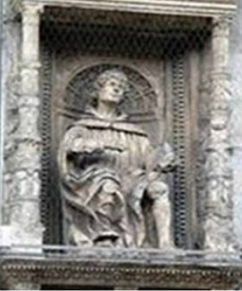
Pliny the Younger-Wikimedia Commons
by Kathy Warnes
The letters of Pliny the Younger give modern people a glimpse of the world of ancient Rome. He even wrote a version of an ancient ghost story.
Born in the year 61 of the common era, Pliny the Younger belonged to the wealthy Caecilius family at Comum in northern Italy. He probably received his early education from tutors at home and then went to Rome to study when he got older. When his uncle Pliny the Elder died in the Mount Vesuvius eruption in CE 79, Pliny the Younger inherited his uncle’s entire estate.
Pliny the Younger Becomes a Lawyer at Age Eighteen
When he turned 18, Pliny began his career as a lawyer and at age 20, he entered the Roman magistracy and held a variety of posts over the next thirty years. These posts included a seat on the court that heard inheritance cases, president of the board in charge of the banks of the Tiber and the Roman sewer system, and positions in the military, senatorial treasuries and the consulship. In 110CE, Trajan sent him to Bithynia, an ancient province that corresponds roughly to present day central-northern Turkey, to investigate corruption.He died there in 113 CE.
Pliny Makes Letter Writing an Art
Pliny the Younger wrote fascinating letters and he left a collection of them that opens the curtains of time and allows modern readers glimpses into public and private lives during the Roman Empire. His letters are preserved in ten books, the first nine containing 247 personal letters and the tenth his official correspondence with Trajan from Bithynia. Pliny himself chose, rewrote, and arranged the letters in books one through nine and his letters in book ten were published after he died.
Each of Pliny’s letters had a single subject and were written with a style to suit the theme. Some were historical, some poetical, and some oratorical. Some were written to young men that Pliny mentored. Many of Pliny’s letters were about moral, philosophical, political, or literary subjects and many dealt with business and litigation. One told of his third wife’s devotion and one discussed the existence of ghosts and contained a ghost story.
Mount Vesuvius Erupts
One of the most famous of Pliny the Younger’s letters was the one that he wrote to Tacitus about the death of his uncle, Pliny the Elder. Pliny the Elder was the praefect in charge of the naval fleet at Misenum in 79 CE, and he lived there in a villa with his nephew, Pliny the Younger, and his mother.
When Mount Vesuvius erupted, Pliny the Elder saw the beginning of the eruption across the Bay of Naples and he ordered his men to make a boat ready. He invited his nephew, Pliny the Younger, to accompany him, but his nephew declined because he was doing a “writing exercise.” Pliny the Elder took his boat directly into danger as he continuously observed the varied movements and the shapes of the clouds that came from the volcano.
Pliny the Elder launched the quadriremes-ships with four sets of oars- and moved along the shore picking up fleeing people. The closer they got to Vesuvius, the clouds became darker and more dense and showers of ash fell onto the ships. Despite the pumice and rocks blocking the shore, Pliny the Elder ordered his helmsman to “Head for Pomponianus,” who was one of his friends.
Pliny the Elder Explores the Situation
At Stabae, on the other side of the Bay of Naples, Pomponianus had loaded up his ships and planned to leave as soon as the winds turned favorable. The same unfavorable winds carried Pliny the Elder to Pomponianus and they sought shelter in his home. Pliny the Elder acted as through this was an ordinary visit and Mount Vesuvius was not erupting all around them.
After he had eaten dinner and rested, Pliny, Pomponianus and the others with them discussed whether they should remain under cover or take refuge in the open air. A series of strong tremors rocked the buildings, but the danger outside came from pumice that kept raining down from Mt. Vesuvius.
Seeking Refuge Outdoors
Pliny the Elder and Pomponianus and the others decided to seek refuge outdoors. Tying pillows on top of their heads to protect themselves from the rock showers, they took up their torches to light the way through the thick darkness and made their way down to the shore to see if it were possible to escape by sea. The waters of the Bay of Naples moved like gladiators in the arena.
Pliny the Elder rested in the shade of a sail and took a few drinks of the cold water that he had requested. Next came the smell of sulfur as forerunner of the flames and then the flames themselves. Everyone else fled, but Pliny the Elder stayed in place. Two small slaves supported him and he stood up and then immediately collapsed.
Pliny the Younger Reports His Uncle's Death
Pliny the Younger, who got his account of his uncle’s death from an eyewitness, said that the dust laden air obstructed his uncle's breathing and his insides which were never strong, simply stopped working. Two days later when daylight returned, people found his untouched body in the clothing that he had put on before he died.
According to the eyewitness, he looked more asleep than dead. Pliny the Younger concluded his letter by saying that he had written out everything that he did and heard at the time while memories were still fresh. “You will use the important bits, for it is one thing to write a letter, another to write history, one thing to write to a friend, another to write for the public.”
Pliny the Younger's Letters Reveal His Personality
The letters of Pliny the Younger provide an invaluable source for the political and social history of Rome during his life and they are a snapshot of Pliny’s personality. They reveal him to be efficient, loyal, shrewd, and magnanimous- the kind of person who made the complex and extensive Roman Empire work.
References
Walsh, P.G. Complete Letters by Pliny the Younger, Oxford Classics, 2009
Pliny the Younger, Vesuvius, Iron Bear Press, 2008.
Pliny the Younger's Ghost Story from Ancient Athens
Pliny the Younger wrote more than 247 personal letters and he also possessed an active imagination and an inquiring mind. In one of his letters he discusses the possibility of ghosts and then he produced his own version of an ancient ghost story. Ancient authors wrote a version of this story, including his friend, the historian Tacitus. The story should sound familiar to modern ghost story readers because it contains the elements of the modern horror tale including the restless corpse, chains rattling, and the beckoning bony finger. Here is Pliny’s paraphrased story, with a link to the original.
A certain house in Athens stood spacious and open, but it’s reputation hovered above it like a dark thundercloud or a cave of inky bats with gleaming eyes. When the darkness deepened into midnight a noise like the clashing of iron came from the house. A frightened, careful listener would identify the noise as the rattling of chains. In the beginning the noise came faintly from a distance, but gradually grew louder and nearer until suddenly the phantom appeared. The phantom appeared in the form of a pale old man with a long beard and wind swirled hair. The chains on his hands and feet rattled as he moved.
Anyone staying in the house couldn’t sleep because of the appearance of the phantom and his chains rattling. The sleepless nights drove the humans in the house into a state of madness. The sights and sounds of the phantom drove some of the human inhabitants of the house to their deaths. Even in the daytime when the phantom didn’t appear his memory hovered in the air and in the minds of those who had seen him in the night.
Eventually, people stopped visiting the house or trying to live in it. It stood deserted, waiting for someone unaware of its history or phantom to come and live in it. A sign that advertised the house for rent or sale still stood in front of it, but it also highlighted the emptiness of the house for many years.
Then, a philosopher named Athenodorus came to Athens and he needed a place to live. He happened upon the silent empty house and read the posted bill complete with its price. He felt a little suspicious because of the cheapness of the house, but even when he heard about the deadly phantom he still remained eager to take the house. He took it and moved in immediately.
As night approached, Athenodorus asked the servants to prepare a coach for him in the front section of the house and he asked for a light and writing materials. After the servants had brought him everything he needed, Athenodorus dismissed them. As he sat there alone in the haunted house, he focused on his writing to keep from being distracted by fear of imaginary noises and phantoms.
For a time Athenodorus just heard the scratching of his pen. Then, faintly, ever so faintly, he heard the rattling of chains. Athenodorus didn’t look up or stop writing. He fiercely concentrated on his work. The noise of chains came closer and closer, until they seemed to be rattling in the doorway, and then in the same room with him. Finally, Athenodorus looked around and there he saw the phantom, exactly as other people had described it. The phantom stood in front of Athenodorus, beckoning to him with one finger.
Athenodorus held up his hand in a stop motion, indicating that the phantom should wait for a minute and he bent over his work again. The phantom impatiently shook his chains over the philosopher’s head, beckoning to him again. Athenodorus and the phantom performed this silent ballet for a few minutes until finally, Athenodorus stood up, picked up his lamp, and followed the impatient phantom. The phantom moved slowly, as if its chains were holding it back. The phantom and Athenodorus reached the courtyard and suddenly, the phantom vanished.
Athenodorus stood alone in the dark and suddenly picked up a handful of grass and leaves. He marked the spot where the phantom vanished with the grass and leaves. The next day Athenodour asked the magistrate for permission to have servants dig in the spot where the phantom had disappeared. The workers dug up bones intertwined with chains that had lain in the ground for a long time. The workers carefully collected the bones which were buried properly at public expense. The restless, impatient phantom received a proper burial at last and he no longer haunted the house in Athens that Athenodorus occupied.
