WINDOWS TO WORLD HISTORY
  • Home
  • Bishop Walter Hawkins: Protected by the British Lion
  • World History Windows
  • The White Roses Defy the Nazis
  • Elias Lonnrot Compiles the Kalevala
  • Because You Were Here We Are Enriched
  • Provocative People
    • Stephane Hessel Wrote Indignez Vous
    • Writer Lafcadio Hearn Merged Greek and Japanese Cultures
    • Are Paul Redfern and the Port of New Brunswick Buried in the Amazon Jungle?
    • Hans Brinker, the Dutch Hero Who Isn't Really Dutch!
    • Rudolf Vrba and Alfred Wetzler Fled Auschwitz and Wrote a Report
    • Roman Emperor Caligula and His Legendary Lake Nemi Ships
    • Rabbi Robert Serebrenik Defies Adolf Eichmann to Save Luxembourg Jews
    • The Confederados Become Brazilian, but Honor Their Southern Roots
    • Pliny the Younger Wrote Letters about His Life in Ancient Rome
    • Hannes Hafstein, Iceland's Poet-Prime Minister, Works for a Cable
    • Mermen Are Important Players in Scandinavian Culture and History
    • William Tell, Mythical Hero, Mythical Historical Figure, or Both?
    • Fritz Thyssen Helped Finance the Nazi Party, but Later Changed His Mind
    • Leif Ericson and L'Anse Meadows
    • Sigrid and Eirikr Magnusson Contributed Much to Iceland's Culture
    • Clara and Henry Leffingwell - An English, Australian, and American Story
    • Per Jacobsen, Norwegian Ice Skater and Resistance Fighter
    • Poul La Cour Pioneered Wind Power in Denmark
    • Michel Linovich- an Italian in Napoleon's Grand Army
    • Solomon Linda, the Lion Sleeps Tonight
    • Sergei Rachmaninoff Composed Rhapsody at Senar, His Swiss Villa
  • Raoul Wallenberg, the Hero Who Never Returned to Sweden
  • Jean Baptiste Sipido Tries to Assassinate the Prince of Wales
  • The Legend of the Hermit of Cape Maleus in Greece Transcends Time
  • Happy Hands-On Historical New Year!
  • Christmas Around the World
    • A Christmas Tribute to Captain Henry Waskow
    • European Christmases in Centuries Past
    • Chasing and Capturing the Fugitive Spirit of Father Christmas
  • Women in World History
  • Madam Elisabeth Thible is the First Woman to Ride in a Free Floating Balloon
  • Nurse Edith Cavell Had The Courage to Die for Her Country
  • Gertrud Scholtz-Klink Followed Hitler Her Entire Life
  • Suzanne Valadon and Maurice Utrillo - Artists of Montmartre
  • SOE Agent Andree Borrel Lived Several Lifetimes in Her 24 Years
  • Queen Alexandra of Great Britain - Queen Victoria's Daughter-in-Law, Bertie's Patient Wife, and Her Own Person
  • Maria Gulovich Liu Joined the Czech Resistance, Won the Bronze Star and became an American Citizen
  • Francoise Marie Jacquelin, Lioness of Latour, Lioness of Acadia, Woman in her Own Right
  • Grand Duchess Marie Adelaide of Luxembourg is a Symbol of Effective Rule
  • Clara Zetin Speaks Against Hitler in the German Reichstag
  • Madam Sophie Blanchard - Official Aeronaut of the Restoration
  • Queen Amelia Maria, the Last Queen of Portugal, Stood Her Ground
  • Places for Posterity
  • Haunted Church Bells Ring in Boscastle and Tintagel in Cornwall
  • Vienna Plague Defenses Included Plague Hospitals
  • The Plundering Plague and the Downfall of the Republic of Venice
  • Ostend Belgium
  • Centuries of History and Ghosts Haunt Denmark's Dragsholm Castle
  • Does Jacques LeRay Chaumont Still Haunt Chaumont Castle?
  • Soldier's Stories
  • Napoleon Bonaparte Ignores His Little Red Man of Destiny
    • The French Revolution Has More Phases than the Moon!
    • Napoleon Bonaparte Still Owes Innkeeper Hippolyte Baretta Sixty Francs!
    • Australian War Correspondent Alan Moorehead Returns to His Roots
    • General Christian Christensen is a Dual Citizen of Denmark and the United States
    • In 1919, Villagers and Soldiers Helped Rebuild Chateau-Thierry
    • The Dudman Family Lived the Meaning of Patriotism and Sacrifice During World War II
    • Five French Boys Canoe the English Channel
    • Stalin's Spin Doctors
    • Maurice Maeterlinck Encounters American Customs
    • Carl von Ossietzky Wins the Nobel Prize While in a Nazi Prison Camp
    • Flying Kites Through All Seasons, Countries, and Histories
  • World History 101
    • Pieces of World- History Puzzle
    • World History Puzzles - the Old World Meets the New World

Historical Time and Tides Ebb and Flow in Ostend, Belgium
Picture
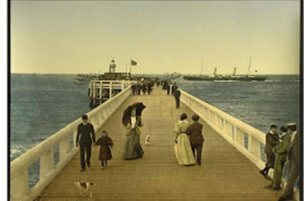
Pier- Ostend, Belgium

By Kathy Warnes

The illimitable, silent, never-resting thing called Time, rolling, rushing on, swift, silent, like an all-embracing ocean tide, on which we and all the universe swim like exhalations, like apparitions which are, and then are not…” Thomas Carlyle

 Time and tide....The North Sea tide has ebbed and flowed in Ostend, Belgium, for centuries, but each year it brings in new  historical happenings and human polar bears. One of the tides of time journeys from August  1900 when Ostend was the most fashionable bathing resorts on the continent of Europe and Luigi managed the Royale Palace Hotel. Another tide from the same month carries echoes from the visit of the Shah of Persia and the attitude war between the English and Belgians because a Flemish Court had acquitted Jean-Baptiste Victor Sipido who attempted to assassinate the Prince of Wales in Brussels. More recent tides welcome more than  6,000 swimmers in Ostend every January, when they undertake their annual polar bear plunge into the timeless, chilly North Sea waters.

  Ostend, August 19, 1900 

In an August 10, 1900, story S. Sieverts Drewett, Travel Editor of the  Brooklyn Eagle, called Ostend the most fashionable bathing station in all Europe. He noted that the English were not as visible at Ostend as in the past, but Americans were better represented. According to Editor Drewett, Americans liked Ostend better and visited it more often than any other coast resorts in Europe because it had a magnificent casino, a fine band, and a superb sand beach. He said that beach visitors at Ostend dress the best and the Ostend hotels were the finest and most attractive of any European shore.
Editor Drewett especially sang the praises of the Royal Palace Hotel which opened in 1899, and then closed for more remodeling.

He reported that it had reopened in 1900 under the direction of Luigi, the popular and long time directing manager of Shepheard’s Hotel at Cairo, Egypt. He described Luigi as a “most charming man, Austrian by birth, and perhaps the most capable of all hotel directors in Europe.”

He also managed the “Ostend Extension," which Maria Kerke was called,  which ran from the King of the Belgian’s summer residence on the Digue or dike a few miles southwestward. The Royal Palace Hotel occupied the largest space as a building of any hotel in Europe. Walled in by a colonnade, it featured twelve full sized tennis courts, and walks in the gardens for cycling and strolling. No private villas or cottages lined the long Digue from one end to the other. In fact, the only cottage on the Digue belonged to the King of Belgium. It was a very modest building that could be mistaken for the home of a retired tradesman of moderate means and if the sentries weren’t visible, no one would suspect it was the summer home of a European ruler.

The Shah of Persia Visits Ostend

During the week of August 15, 1900, Luigi, proprietor of the Ostend Royale Palace Hotel, prepared for an important visitor. Mozaffar ad-Din Shah Qajar, The Shah of Persia-modern day Iran- planned to visit Ostend and he and his company of sixty people would occupy an entire floor of the hotel, complete with a special entrance.

The Shah had decided to visit Ostend instead of England because of the mourning in England and the diplomatic unrest between England and Belgium. Alfred, Duke of Saxe-Coburg and Gotha, the second son and fourth child of Queen Victoria and Prince Albert of Saxe-Coburg and Gotha had died on July 30, 1900 and the entire English court mourned him. The continued South African War had bereaved hundreds of upper class English families. The English foreign policy toward Persia had not been very successful and the Shah chose to avoid England on his visit and seek a neutral country like Belgium for the rest of his European stay.

 Thomas Walsh, the Mining Multi-Millionaire Visits King Leopold at Ostend

The Royal Palace Hotel was so large that the Shah and his party of 60 could move about freely in their suite without encountering crowds of visitors in other parts of the hotel. If he did decide to socialize, there were many well known Americans visiting the Royal Palace Hotel. Mr. and  Mrs. Thomas F. Walsh were among the current American guests and they had decided to remain over the Shah’s visit.

Thomas Walsh had climbed from being a poor Irish immigrant in America to a mining multi-millionaire and had taken his Wisconsin born wife, Carrie Reed Wash with him. President William McKinley appointed him as a Commission from the state of Colorado to the Paris Exposition of 1900 which lasted from April 15, to November 12, 1900. Thomas Walsh turned a Seine River steamer into a floating palace and gave a $40,000 dinner to a group of distinguished men. He chartered a train of five palace cars and fitted it with silk and decorations which he used on his steamer and  toured France and Belgium. 

King Leopold of Belgium met Thomas Walsh at Ostend and Thomas Walsh gave a dinner at the Hotel Ritz in honor of King Leopold. The Czar’s band and opera singers from Paris provided the music for the dinner. King Leopold developed extensive mining interests in Africa and it was through Mr. Walsh that experts were sent to investigate these properties and report on their value. In a sense, Leopold the King of Belgium became a partner of Thomas Walsh the multi-millionaire miner.

 The Atlantic Wall in Ostend

Twentieth Century tides carried much more alarming history. On March 23, 1942, in Fuhrer Directive Number 40, Adolf Hitler mandated the creation of the Atlantic Wall consisting of permanent fortifications along the Dutch, Belgian, and French coasts facing the English Channel.

After he was assigned to improve the Atlantic Wall’s defenses early in 1944, Field  Marshal Erwin Rommel immediately began strengthening them because he believed they were entirely inadequate. His goal was to destroy Allied landing craft before they could unload for any kind of invasion of the European continent. He directed slave laborers to build a string of reinforced concrete pillboxes to be built along the beaches or slightly inland to protect machine guns, antitank guns, and light artillery. They  placed mines and antitank obstacles on the beaches themselves, and they mined the waters just offshore.

In Ostend, the Germans installed emplacements of the "Saltzwedel neu battery" and the "Stutzpunkt Bensberg," consisting of several men's quarters and other facilities. A unit of Germany military engineers called  Pionierstab- who were in charge of bunker construction used them. The  Ostend part of the Atlantic Wall is well preserved and available for public visits.

Ostend Welcomes Human Polar Bears

In January of every year,  the timeless tides touch thousands of human polar bears on the beach opposite Drie Gapers in Ostend when they splash into the North Sea. There were more than 6,000 people plunging into the chilly water in 2011 and 2012 and more expected in the future.

 Time and Tide... 

References 

Blythe, Derke. Flemish Cities Explored: Bruges, Ghent, Antwerp, Mechelen, Leuven & Ostend. Pallas Athene, 2003.
Saunders, Anthony. Hitler's Atlantic Wall. Sutton Publishing, 2001.



Powered by Create your own unique website with customizable templates.
  • Home
  • Bishop Walter Hawkins: Protected by the British Lion
  • World History Windows
  • The White Roses Defy the Nazis
  • Elias Lonnrot Compiles the Kalevala
  • Because You Were Here We Are Enriched
  • Provocative People
    • Stephane Hessel Wrote Indignez Vous
    • Writer Lafcadio Hearn Merged Greek and Japanese Cultures
    • Are Paul Redfern and the Port of New Brunswick Buried in the Amazon Jungle?
    • Hans Brinker, the Dutch Hero Who Isn't Really Dutch!
    • Rudolf Vrba and Alfred Wetzler Fled Auschwitz and Wrote a Report
    • Roman Emperor Caligula and His Legendary Lake Nemi Ships
    • Rabbi Robert Serebrenik Defies Adolf Eichmann to Save Luxembourg Jews
    • The Confederados Become Brazilian, but Honor Their Southern Roots
    • Pliny the Younger Wrote Letters about His Life in Ancient Rome
    • Hannes Hafstein, Iceland's Poet-Prime Minister, Works for a Cable
    • Mermen Are Important Players in Scandinavian Culture and History
    • William Tell, Mythical Hero, Mythical Historical Figure, or Both?
    • Fritz Thyssen Helped Finance the Nazi Party, but Later Changed His Mind
    • Leif Ericson and L'Anse Meadows
    • Sigrid and Eirikr Magnusson Contributed Much to Iceland's Culture
    • Clara and Henry Leffingwell - An English, Australian, and American Story
    • Per Jacobsen, Norwegian Ice Skater and Resistance Fighter
    • Poul La Cour Pioneered Wind Power in Denmark
    • Michel Linovich- an Italian in Napoleon's Grand Army
    • Solomon Linda, the Lion Sleeps Tonight
    • Sergei Rachmaninoff Composed Rhapsody at Senar, His Swiss Villa
  • Raoul Wallenberg, the Hero Who Never Returned to Sweden
  • Jean Baptiste Sipido Tries to Assassinate the Prince of Wales
  • The Legend of the Hermit of Cape Maleus in Greece Transcends Time
  • Happy Hands-On Historical New Year!
  • Christmas Around the World
    • A Christmas Tribute to Captain Henry Waskow
    • European Christmases in Centuries Past
    • Chasing and Capturing the Fugitive Spirit of Father Christmas
  • Women in World History
  • Madam Elisabeth Thible is the First Woman to Ride in a Free Floating Balloon
  • Nurse Edith Cavell Had The Courage to Die for Her Country
  • Gertrud Scholtz-Klink Followed Hitler Her Entire Life
  • Suzanne Valadon and Maurice Utrillo - Artists of Montmartre
  • SOE Agent Andree Borrel Lived Several Lifetimes in Her 24 Years
  • Queen Alexandra of Great Britain - Queen Victoria's Daughter-in-Law, Bertie's Patient Wife, and Her Own Person
  • Maria Gulovich Liu Joined the Czech Resistance, Won the Bronze Star and became an American Citizen
  • Francoise Marie Jacquelin, Lioness of Latour, Lioness of Acadia, Woman in her Own Right
  • Grand Duchess Marie Adelaide of Luxembourg is a Symbol of Effective Rule
  • Clara Zetin Speaks Against Hitler in the German Reichstag
  • Madam Sophie Blanchard - Official Aeronaut of the Restoration
  • Queen Amelia Maria, the Last Queen of Portugal, Stood Her Ground
  • Places for Posterity
  • Haunted Church Bells Ring in Boscastle and Tintagel in Cornwall
  • Vienna Plague Defenses Included Plague Hospitals
  • The Plundering Plague and the Downfall of the Republic of Venice
  • Ostend Belgium
  • Centuries of History and Ghosts Haunt Denmark's Dragsholm Castle
  • Does Jacques LeRay Chaumont Still Haunt Chaumont Castle?
  • Soldier's Stories
  • Napoleon Bonaparte Ignores His Little Red Man of Destiny
    • The French Revolution Has More Phases than the Moon!
    • Napoleon Bonaparte Still Owes Innkeeper Hippolyte Baretta Sixty Francs!
    • Australian War Correspondent Alan Moorehead Returns to His Roots
    • General Christian Christensen is a Dual Citizen of Denmark and the United States
    • In 1919, Villagers and Soldiers Helped Rebuild Chateau-Thierry
    • The Dudman Family Lived the Meaning of Patriotism and Sacrifice During World War II
    • Five French Boys Canoe the English Channel
    • Stalin's Spin Doctors
    • Maurice Maeterlinck Encounters American Customs
    • Carl von Ossietzky Wins the Nobel Prize While in a Nazi Prison Camp
    • Flying Kites Through All Seasons, Countries, and Histories
  • World History 101
    • Pieces of World- History Puzzle
    • World History Puzzles - the Old World Meets the New World