WINDOWS TO WORLD HISTORY
  • Home
  • Bishop Walter Hawkins: Protected by the British Lion
  • World History Windows
  • The White Roses Defy the Nazis
  • Elias Lonnrot Compiles the Kalevala
  • Because You Were Here We Are Enriched
  • Provocative People
    • Stephane Hessel Wrote Indignez Vous
    • Writer Lafcadio Hearn Merged Greek and Japanese Cultures
    • Are Paul Redfern and the Port of New Brunswick Buried in the Amazon Jungle?
    • Hans Brinker, the Dutch Hero Who Isn't Really Dutch!
    • Rudolf Vrba and Alfred Wetzler Fled Auschwitz and Wrote a Report
    • Roman Emperor Caligula and His Legendary Lake Nemi Ships
    • Rabbi Robert Serebrenik Defies Adolf Eichmann to Save Luxembourg Jews
    • The Confederados Become Brazilian, but Honor Their Southern Roots
    • Pliny the Younger Wrote Letters about His Life in Ancient Rome
    • Hannes Hafstein, Iceland's Poet-Prime Minister, Works for a Cable
    • Mermen Are Important Players in Scandinavian Culture and History
    • William Tell, Mythical Hero, Mythical Historical Figure, or Both?
    • Fritz Thyssen Helped Finance the Nazi Party, but Later Changed His Mind
    • Leif Ericson and L'Anse Meadows
    • Sigrid and Eirikr Magnusson Contributed Much to Iceland's Culture
    • Clara and Henry Leffingwell - An English, Australian, and American Story
    • Per Jacobsen, Norwegian Ice Skater and Resistance Fighter
    • Poul La Cour Pioneered Wind Power in Denmark
    • Michel Linovich- an Italian in Napoleon's Grand Army
    • Solomon Linda, the Lion Sleeps Tonight
    • Sergei Rachmaninoff Composed Rhapsody at Senar, His Swiss Villa
  • Raoul Wallenberg, the Hero Who Never Returned to Sweden
  • Jean Baptiste Sipido Tries to Assassinate the Prince of Wales
  • The Legend of the Hermit of Cape Maleus in Greece Transcends Time
  • Happy Hands-On Historical New Year!
  • Christmas Around the World
    • A Christmas Tribute to Captain Henry Waskow
    • European Christmases in Centuries Past
    • Chasing and Capturing the Fugitive Spirit of Father Christmas
  • Women in World History
  • Madam Elisabeth Thible is the First Woman to Ride in a Free Floating Balloon
  • Nurse Edith Cavell Had The Courage to Die for Her Country
  • Gertrud Scholtz-Klink Followed Hitler Her Entire Life
  • Suzanne Valadon and Maurice Utrillo - Artists of Montmartre
  • SOE Agent Andree Borrel Lived Several Lifetimes in Her 24 Years
  • Queen Alexandra of Great Britain - Queen Victoria's Daughter-in-Law, Bertie's Patient Wife, and Her Own Person
  • Maria Gulovich Liu Joined the Czech Resistance, Won the Bronze Star and became an American Citizen
  • Francoise Marie Jacquelin, Lioness of Latour, Lioness of Acadia, Woman in her Own Right
  • Grand Duchess Marie Adelaide of Luxembourg is a Symbol of Effective Rule
  • Clara Zetin Speaks Against Hitler in the German Reichstag
  • Madam Sophie Blanchard - Official Aeronaut of the Restoration
  • Queen Amelia Maria, the Last Queen of Portugal, Stood Her Ground
  • Places for Posterity
  • Haunted Church Bells Ring in Boscastle and Tintagel in Cornwall
  • Vienna Plague Defenses Included Plague Hospitals
  • The Plundering Plague and the Downfall of the Republic of Venice
  • Ostend Belgium
  • Centuries of History and Ghosts Haunt Denmark's Dragsholm Castle
  • Does Jacques LeRay Chaumont Still Haunt Chaumont Castle?
  • Soldier's Stories
  • Napoleon Bonaparte Ignores His Little Red Man of Destiny
    • The French Revolution Has More Phases than the Moon!
    • Napoleon Bonaparte Still Owes Innkeeper Hippolyte Baretta Sixty Francs!
    • Australian War Correspondent Alan Moorehead Returns to His Roots
    • General Christian Christensen is a Dual Citizen of Denmark and the United States
    • In 1919, Villagers and Soldiers Helped Rebuild Chateau-Thierry
    • The Dudman Family Lived the Meaning of Patriotism and Sacrifice During World War II
    • Five French Boys Canoe the English Channel
    • Stalin's Spin Doctors
    • Maurice Maeterlinck Encounters American Customs
    • Carl von Ossietzky Wins the Nobel Prize While in a Nazi Prison Camp
    • Flying Kites Through All Seasons, Countries, and Histories
  • World History 101
    • Pieces of World- History Puzzle
    • World History Puzzles - the Old World Meets the New World

A Christmas Tribute to Captain Henry Waskow

Picture
Captain Henry Waskow-Wikimedia Commons


by Kathy Warnes


Over six decades have come and gone since Captain Henry Waskow died in Italy during the Christmas holidays, 1943. Ernie Pyle wrote that the dead are not just columns of figures and ironically, he made Captain Waskow come alive for his readers by writing the story of his death.

A Christmas Salute to Captain Henry Waskow

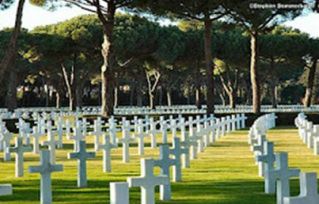
Captain Henry T. Waskow’s grave is marked by one of an immense  army of 7,861 crosses and stars of David that march in gentle curves over broad green lawns stretching underneath rows of Roman pine trees in the World War II Sicily-Rome American Cemetery.

The Cemetery is located at the north edge of the town of Nettuno, which is immediately east of Anzio, 38 miles south of Rome, Italy. Most of the soldiers died liberating Sicily in July and August 1943, and in the landings in Salerno. They fell in the heavy fighting northward of Salerno in September 1943, and during the Anzio Beach and beachhead expansions from January to May 1944.

If it weren’t for Ernie Pyle, no one outside of his immediate family and friends and the men who served with him in the 36th Infantry Division would know Captain Henry Waskow. A war correspondent for Scripps Howard Newspapers, Ernie walked, talked, ate and slept on the battlefields of Europe with the infantry and he happened to be in San Pietro, Italy, when Captain Waskow’s men brought his body down from Mount Sammucro.  Because of Ernie Pyle, so many visitors ask to see Captain Waskow’s grave that the caretaker no longer has to look up its location. He leads the visitors to Plot G Row 6, Grave 33 by well worn memory.

Henry Waskow of Belton, Texas

In an ironic twist of genealogy and history, Henry Waskow- who believed that the leaders of Nazi Germany were evil and was killed by German soldiers who never saw his face- had a German family tree. He descended from four grandparents who were born in Germany and some of his older brothers and sisters did their school lessons in German.

Born September 24, 1918, in DeWitt County, Texas, Henry Thomas Waskow was the seventh of eight children. His parents were cotton farmers who lived in various Texas towns until they settled in Belton, Texas, when Henry was two years old. In Belton High School, he served as president of the student council and received top grades, showing a special gift for mathematics. He graduated in 1935 and attended Temple Junior College on a scholarship, often walking back and forth from his parent’s home and working as a janitor on campus.

Captain Waskow Fights with the 36th Infantry Division

While he attended college, Henry enlisted in the Texas Army National Guard, in the 143rd Infantry Regiment, 36th Infantry division. His two older brothers, John Otto and August served with him. Henry earned a bachelor’s degree from Trinity University in 1939 and turned down a teaching job at Belton High School because he expected to be called for full time military duty.
President Franklin D. Roosevelt activated the 36th Infantry Division and Henry received his commission as lieutenant on March 14, 1941 and was assigned to Company B, First Battalion, 143rd Regiment. While he served at Camp Edward in Falmouth, Massachusetts, he was promoted to captain and met a dark haired young woman that he loved but never had a chance to marry.

In April 1943, the 36th shipped overseas to Algeria and then Rabat, Morocco and finally landed in Italy as part of Operation Avalanche. Captain Waskow, 25, saw combat for the first time as commander of Company B.

Captain Henry Waskow never asked his men to face dangers that he wouldn’t face himself and he took care of their needs, including the time he made sure they had a Turkey for Thanksgiving dinner instead of cold water and chocolate bars in the front lines.
His men felt the same way about him. Riley Tidwell of Gallatin, Texas, served as Captain Waskow’s driver and brought his body down Hill 1205, despite the shell fire and frostbite.

In December 1943, Captain Henry T. Waskow and his men of the 36th Infantry Division marched on mountain trails to Mount Sammucro or Hill 1205 near San Pietro. They had fought their way past Naples as part of the Allied push to Rome and now they were fighting the battle for San Pietro to set the stage for the assault on the abbey town of Cassino.

On Tuesday, December 14, 1943, Captain Waskow and his men were on the way up from the tree line to attack a ridge called Hill 730, when the German artillery barrage struck. A shell hit near Captain Waskow and his men and shrapnel caught him in the chest, killing him in seconds.

Ernie Pyle’s Column- “The Death of Captain Waskow

Riley Tidwell, who had served as Captain Waskow's driver and assistant throughout the war, left the Captain’s body where he had fallen and hurried down the mountain to report his death. At the bottom of the mountain, he saw a short, thin, man, that he judged too old to be a soldier. The man wore a wool cap, and carried a bag and pocket sized notebook. Tidwell discovered the man’s name was Ernie Pyle. Ernie Pyle and Riley Tidwell waited the three days it took to bring Captain Waskow’s body down the mountain on the back of a mule.

In his newspaper column, ”The Death of Captain Waskow,” Ernie Pyle described Riley Tidwell squatting down and holding Captain Waskow’s  hand in his own for five minutes and looking intently into the dead face. “Finally he put the hand down, and then reached up and gently straightened the points of the captain’s shirt collar, and then he sort of rearranged the tattered edges of his uniform around the wound. And then he got up and walked away down the road in the moonlight all alone.”

Captain Henry Waskow received the Legion of Merit posthumously and also the Purple Heart. His family erected a memorial stone in North Cemetery in Belton near the graves of his mother who died two months after Henry was killed and his father who died in 1957. The Belton Post 4008 of the Veterans of Foreign Wars place flags on Henry’s marker on Memorial Day.

Ernie Pyle published his column, “The Death of Captain Waskow,” on January 10, 1944. Shortly after that, stacks of letters expressing sympathy and good wishes began to arrive in Belton, Texas, addressed to Captain Waskow’s family

The letter that meant the most to them was a letter from Henry Waskow himself. In his last letter home, Henry said in part…Yes, I would have liked to have lived – to live and share the many blessings and good fortunes that my grandparents bestowed upon me…I made my choice, dear ones. I volunteered in the Armed Forces because I thought that I might be able to help this great country of ours in its hours of darkness and need…if I have done that, then I can rest in peace, for I will have done my share to make the world a better place in which to live..”

References

Clark, Lloyd. Anzio: Italy and the Battle for Rome, 1944. Atlantic Monthly Press, 2006

Pyle, Ernie. Brave Men. Bison Books, 2001

Sheehan, Fred. Anzio, Epic of Bravery. University of Oklahoma Press, 1994

Tobin, James. Ernie Pyle’s War: American’s Eyewitness to World War II. Free Press, May 2006.


Powered by Create your own unique website with customizable templates.
  • Home
  • Bishop Walter Hawkins: Protected by the British Lion
  • World History Windows
  • The White Roses Defy the Nazis
  • Elias Lonnrot Compiles the Kalevala
  • Because You Were Here We Are Enriched
  • Provocative People
    • Stephane Hessel Wrote Indignez Vous
    • Writer Lafcadio Hearn Merged Greek and Japanese Cultures
    • Are Paul Redfern and the Port of New Brunswick Buried in the Amazon Jungle?
    • Hans Brinker, the Dutch Hero Who Isn't Really Dutch!
    • Rudolf Vrba and Alfred Wetzler Fled Auschwitz and Wrote a Report
    • Roman Emperor Caligula and His Legendary Lake Nemi Ships
    • Rabbi Robert Serebrenik Defies Adolf Eichmann to Save Luxembourg Jews
    • The Confederados Become Brazilian, but Honor Their Southern Roots
    • Pliny the Younger Wrote Letters about His Life in Ancient Rome
    • Hannes Hafstein, Iceland's Poet-Prime Minister, Works for a Cable
    • Mermen Are Important Players in Scandinavian Culture and History
    • William Tell, Mythical Hero, Mythical Historical Figure, or Both?
    • Fritz Thyssen Helped Finance the Nazi Party, but Later Changed His Mind
    • Leif Ericson and L'Anse Meadows
    • Sigrid and Eirikr Magnusson Contributed Much to Iceland's Culture
    • Clara and Henry Leffingwell - An English, Australian, and American Story
    • Per Jacobsen, Norwegian Ice Skater and Resistance Fighter
    • Poul La Cour Pioneered Wind Power in Denmark
    • Michel Linovich- an Italian in Napoleon's Grand Army
    • Solomon Linda, the Lion Sleeps Tonight
    • Sergei Rachmaninoff Composed Rhapsody at Senar, His Swiss Villa
  • Raoul Wallenberg, the Hero Who Never Returned to Sweden
  • Jean Baptiste Sipido Tries to Assassinate the Prince of Wales
  • The Legend of the Hermit of Cape Maleus in Greece Transcends Time
  • Happy Hands-On Historical New Year!
  • Christmas Around the World
    • A Christmas Tribute to Captain Henry Waskow
    • European Christmases in Centuries Past
    • Chasing and Capturing the Fugitive Spirit of Father Christmas
  • Women in World History
  • Madam Elisabeth Thible is the First Woman to Ride in a Free Floating Balloon
  • Nurse Edith Cavell Had The Courage to Die for Her Country
  • Gertrud Scholtz-Klink Followed Hitler Her Entire Life
  • Suzanne Valadon and Maurice Utrillo - Artists of Montmartre
  • SOE Agent Andree Borrel Lived Several Lifetimes in Her 24 Years
  • Queen Alexandra of Great Britain - Queen Victoria's Daughter-in-Law, Bertie's Patient Wife, and Her Own Person
  • Maria Gulovich Liu Joined the Czech Resistance, Won the Bronze Star and became an American Citizen
  • Francoise Marie Jacquelin, Lioness of Latour, Lioness of Acadia, Woman in her Own Right
  • Grand Duchess Marie Adelaide of Luxembourg is a Symbol of Effective Rule
  • Clara Zetin Speaks Against Hitler in the German Reichstag
  • Madam Sophie Blanchard - Official Aeronaut of the Restoration
  • Queen Amelia Maria, the Last Queen of Portugal, Stood Her Ground
  • Places for Posterity
  • Haunted Church Bells Ring in Boscastle and Tintagel in Cornwall
  • Vienna Plague Defenses Included Plague Hospitals
  • The Plundering Plague and the Downfall of the Republic of Venice
  • Ostend Belgium
  • Centuries of History and Ghosts Haunt Denmark's Dragsholm Castle
  • Does Jacques LeRay Chaumont Still Haunt Chaumont Castle?
  • Soldier's Stories
  • Napoleon Bonaparte Ignores His Little Red Man of Destiny
    • The French Revolution Has More Phases than the Moon!
    • Napoleon Bonaparte Still Owes Innkeeper Hippolyte Baretta Sixty Francs!
    • Australian War Correspondent Alan Moorehead Returns to His Roots
    • General Christian Christensen is a Dual Citizen of Denmark and the United States
    • In 1919, Villagers and Soldiers Helped Rebuild Chateau-Thierry
    • The Dudman Family Lived the Meaning of Patriotism and Sacrifice During World War II
    • Five French Boys Canoe the English Channel
    • Stalin's Spin Doctors
    • Maurice Maeterlinck Encounters American Customs
    • Carl von Ossietzky Wins the Nobel Prize While in a Nazi Prison Camp
    • Flying Kites Through All Seasons, Countries, and Histories
  • World History 101
    • Pieces of World- History Puzzle
    • World History Puzzles - the Old World Meets the New World