Elias Lonnrot Compiles the Kalevala
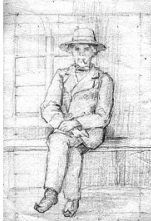
Elias Lonnrot- Wikimedia Commons
by Kathy Warnes
Elias Lonnrot, Finnish physician, linguist, and professor, is most famous as the compiler, editor, and author of Finland’s national epic, the Kalevala.
Elias Lonnrot turned seven years old on April 9, 1809, the same year his native Finland changed as radically as the weather on the Gulf of Finland. Since the Thirteenth Century, Sweden had gradually incorporated what is modern Finland into its own territory and Swedish with Latin became the common language of administration and higher education. Swedish peasants immigrating to Finland’s coastal regions also bolstered the use of Swedish, although Finnish continued to be the core language of most of the Finnish population.
In 1809, Finland signed the Treaty of Hamina, which broke nearly 700 years of territorial ties between Sweden and Finland and attached Finland to the Russian empire as an autonomous Grand Duchy. Now that the Finns were not part of Sweden any longer, they faced the challenges of making radical changes, including linguistic ones, and building their own nationalistic history and culture.
Elias Lonnrot, a Man From Humble Beginnings
Educated Finns spoke Swedish, not Finnish, so with independence from Sweden, the Finns had to create a national language and identity of their own. At age seven, Elias couldn’t image the part that he would play in creating Finland’s national epic, the Kalevala, and its significant role in establishing Finnish as a language and cultural vehicle. Elias also contributed other important folklore, medicine, language and, and science writings, but he is best known for the Kalevala.
Elias Lonnrot came from humble beginnings. His father Fredrik Johan Lonnrot was a tailor and his mother Ulrika Wahlberg Lonnrot, cared for her home and family. The Lonnrot family lived in Sammatti, Finland, in the Province of Southern Finland which is a part of the Uusimau region. The education of Elias proved to be a sporadic endeavor, because of a chronic shortage of family funds.
His oldest brother and his parents helped him financially whenever they could, but Elias worked as a tailor, tutor, or apothecary’s assistant to supplement their help. He enrolled at the University of Turku in the autumn of 1822, and his classmates included Johan Vilhelm Snellman who would later be instrumental in establishing the Finnish nationalist movement, and Johan Ludvig Runeberg, who would someday become Finland’s national poet. These three men would be pivotal in developing Finland’s culture and national identity.
Earning Academic Degrees and Traveling for Folk Poetry
For the next ten years, Elias combined earning his academic degrees with periods of essential employment, eventually earning a medical diploma. As Elias progressed through the University of Turku, he encountered Reinhold von Becker, a Finnish language teacher, who kindled a love of folk poetry in his soul. After Elias received his initial degree in 1828, he went on the first of his many expeditions to collect material. Although he received his medical degree in 1832, he began his true vocation in this initial 1828 expedition.
While collecting material, Elias immersed himself in the rich oral tradition of Finland, and before he graduated from medical school, he published his first collection of folk poetry. He produced four booklets that he called The Kantele, which he released from 1829 to 1831. He finished a fifth booklet that was never published. In 1831, Elias was one of the founding members and first secretary of the Finnish Literature Society, and he also went on another material collecting expedition that he had to cut short because of a cholera epidemic in Helsinki. He stopped in Helsinki to help fight the cholera epidemic because even though he hadn't yet earned his M.D., he had received a masters degree in medicine in 1830 which qualified him to help in such a medical crisis.
Country Doctor and Gatherer of Folk Tales
Elias Lonnrot graduated from medical school in 1832, and the municipality of Oulu hired him as assistant district medical officer. In 1833, he served as district medical officer in Kajaani, a rural area near Russian Karelia, and this would be his home base for the next twenty years. His humble beginnings and struggles for an education helped Elias develop a deep understanding of the lives of ordinary people. In his early years as a doctor, he saw people suffer immensely from the horrors of famine and typhoid which helped him develop empathy for human suffering. Drawing on these qualities, Elias Lonnrot successfully combined the roles of medical doctor and gatherer of folk tales.
Dr. Lonnrot, the Raffish Rake
Dr. Elias Lonnrot favored fun as well as medicine and poetry, and until he reached later middle age he enjoyed the reputation of a raffish rake and all of the exploits and habits that went with the title. He liked to play cards and sometimes he extended his travel budget with the money he won at cards.
Often, he would drink too much and he suffered the pleasure and pain of over-indulgence. In his later years, he stopped drinking and founded the Clearheads Club, Finland's first temperance society. In 1849, when he was 47 years old, Dr. Lonnrot married Maria Piponius, who was over twenty years younger than her husband and a Pietist.
Dr. Lonnrot's Travels
As well as his medical practice and the fun side of his life, Dr. Lonnrot seriously pursued his folklore research, building on his original field trip in 1828, and his interrupted one for medical purposes in 1831. He went on nine more expeditions, searching for the remnants of Finnish society and culture that could still be found in the sung poetry, or runo tradition in the Finnish outposts. In his search for material, Dr. Lonnrot traveled the borderlands of Finland and Russia from Estonia to Lapland to Russian Karelia and beyond.
Along with poetry, Dr. Lonnrot recorded lyrics, charms, fables, riddles, and proverbs. During his fourth trip in September 1833, he decided to create an epic from his collection of material and the Kalevala was born. The Kalevala was a merger of Lonnrot's efforts and of ancient folklore. He arranged the material he had collected into one cohesive poem.
He completed the first edition now called the Old Kalevala in 1849 and in Finland, the epic became the cornerstone of Finnish culture because it marked the onset of Finnish as a literary language. The story soon became world famous. In 1840, Dr. Lonnrot published a companion to the first edition of the Kalevala, a collection of lyric poems and ballads called the Kanteletar. His other folklore writings included Proverbs of the Finnish People in 1842, and Riddles of the Finnish People in 1844.
A Doctor of Many Talents
As well as the Kalevala and Kanteletar epics, Dr. Lonnrot wrote extensively for 11 newspapers and magazines, and he founded The Bee, the first Finnish language magazine, in 1836. He compileted a Swedish-Finnish-German dictionary in 1847, and he followed that up with a Finnish-Swedish dictionary that remained the standard until the beginning of the Twenty-First Century. He published "The Tale of Vorna," one of the first short stories in Finnish literature and created many new Finnish words.
Dr. Lonnrot continued to practice medicine, and true to his vocation, he contributed to the world of scientific literature. His publications in his field included The Finnish Peasant's Home Doctor in 1839, Advice to the People in Ostrobothnia on Rearing and Feeding Children in 1844, and a book about botany called Flora Fennica - Suomen Kasvio in 1862. He was also a talented musician and played the flute and accompanied himself on the traditional Finnish harp called the kantele.
Professor Lonnrot of the University of Helsinki
Adding another dimension to his career, Dr. Lonnrot accepted a position as professor and chair of Finnish Language and Literature at the University of Helsinki. He moved to Helsinki and lived there until he retired in 1862. Then he returned to Sammatti, his native city, and continued to work on several projects, including publishing a book of Finnish magical poems in 1880. He wrote in the Kalevala that "sorrow is the source of singing," but he also believed in progress and in the shining future of Finland.
Dr. Lonnrot died in Sammatti on March 19, 1884, after a long and productive life. Finland celebrates Kalevala Day every year on February 28, and Elias Lonnrot continues to have a lasting impact on Finnish culture and identity.
References
Lonnrot, Elias, The Kanteletar: Lyrics and Ballads After the Oral Tradition, Oxford University Press, 1992
Lonnrot, Elias, The Kalevala, Macmay, 2008
Scandinavian Studies, Fall 2004
UNESCO Courier, August, 1985
