Places for Posterity...
The Plundering Plague and the Downfall of the Republic of Venice
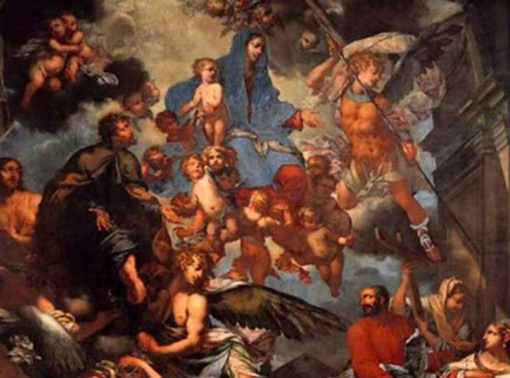
The Madonna Saves Venice from the Plague-Wikimedia Commons
by Kathy Warnes
The Black Death decimated the population of the Republic of Venice in 1630 and undermined its foundations enough to allow Napoleon to overthrow it in 1797. Severely reducing the populations of the Medieval world, the plague is believed to have originated in China, although recent studies contend that its origins were in Egypt. Rats and fleas hitchhiking on ships spread the Bubonic Plague westward to Europe along the Venetian and Genovese trade routes.
History and Geography Aid the Downfall of the Republic of Venice
In the 17th century, Italy’s political structure differed from that of other European states. Italy was composed of separate city states and each city state managed the ravages of the plague individually. These individual city states often cooperated and worked together, but the plague deaths impacted each individual city state more heavily than it did centrally organized countries like France.
Venice Is Geographically Unique
Located in Northern Italy, Venice is a port city which made it a focal point for plague outbreaks that rats and fleas on merchant ships brought in from other ports. Venice is built over 100 low-lying islands in a salt water lagoon which is sheltered from the Adriatic Sea by the Lido- a sandbank- and other small strips of land. Venetians invented unique techniques to fortify their buildings. They used timber and stone, they drove piles into the islands and on these piles they built a structure of wood, followed by brick and then stone for each house or building. Although vulnerable to fire, some of these buildings have stood for over 400 years.
There is a strong link between port cities like Venice and the plague . If the plague had not been able to travel from port to port with the rats and fleas on merchant ships, it probably would have not spread so widely or been so devastating. The fact that Italian city states were so successful as sea traders clearly connects them with the exposure and spread of the Black Death.
Venice in 1630 is Wealthy and Prosperous
Because of its success in trade and shipping, the Republic of Venice had grown into a city of substantial wealth and prosperity by 1630. Venice enjoyed the advantage of being a port city and had built its economy on maritime trade routes. The Venetians had outdistanced Genoa, their fiercest competitor and become the most important mercantile power in the Adriatic. The Venetian Republic had bested its competitors because the government led efforts to increase the wealth of the Republic including signing treaties for peace in the region balanced against building up the military fleet to protect is mercantile interests.
The Invisible Enemy
Wealth and prosperity did not stop bubonic plague. The anatomy of the plague itself was an important factor as well as the fact that medieval physicians possessed a limited understanding of plague and could do nothing to cure it.
Between 1350 and 1700, over 100 epidemics of plague swept over the world, especially over Asia, Europe, and Russia. Historians estimate that about 75 million people died, one third of them in Europe.
The plague came in three varieties, bubonic, pneumonic, and septicemic. The most visible symptom of Bubonic Plague is painful, swollen lymph glands in the armpits, groin, or neck, called buboes, which give Bubonic Plague its name. Bubonic Plague can progress into two other forms called pneumonic and septicemic. Modern scientists have discovered that
bacterium Yersinia pestis causes bubonic plague.
The Plague Makes Numerous Visits to Venice
Venice, Italy, experienced 22 outbreaks of plague between 1361 and 1528. The plague of 1576-1577 killed 50,000 in Venice, almost a third of the population. The 1680 version of the plague was just as deadly. In just seventeen months, 80,000 people in Venice died of the plague. On November 9, 1680 alone, 595 people died.
The Doge Makes a Vow
Nicolo Contarini, the Doge or chief magistrate of the Republic of Venice, made a vow in the name of the Senate. He solemnly pledged to build a church dedicated to the Madonna of Good Health if the Virgin Mary would free Venice from the plague. He also promised that every year on November 21st, the day of Mary’s Presentation in the Temple, he would follow a procession to the church.
Doge Nicolo Contarini died of the plague, but his successor Doge Francesco Erizzo kept the vow, illustrating how deeply Venice dreaded the disease it could not understand and control. By the time the plague ran its course, it had forever altered Venetian politics.
The Venetian military tried to protect all of the Republic’s shipping routes, but the reduction in the ranks left the shipping routes open to attack. With decimated numbers of people left to fight and defend its territories, the Ottoman Turks were able to capture the island of Crete in1669. In 1716, Morea also fell to the Ottoman Turks. In 1797, Venice surrendered sovereignty to Napoleon’s invading French Army, an act that ended 1,070 years of republican government.
Celebrating Carnival each year, Venetians still remember their historic past. They dress up in masks and costumes that represent the Bubonic Plague, the discovery of a quarantine island, a female vampire in Venice, and its impact on their history.
References
Aberth, John, The Black Death: The Great Mortality of 1348-1350: A Brief History with Documents (The Bedford Series in History and Culture, Bedford St. Martins, 2005.
Cantor, Norman F. In the Wake of the Plague: the Black Death and the World It Made, Harper Perennial, 2002.
Gottfried, Robert S., The Black Death: Natural and Human Disaster in Medieval Europe, Free Press, 1985.
Herlihy, David, and Cohn, Samuel K.,Jr., The Black Death and the Transformation of the West (European History Series) Harvard University Press, 1997.
Huppert, George. After the Black Death, Second Edition: A Social History of Early Modern Europe (Interdisciplinary Studies in History) Indiana University Press, 1998.
Kelly, John. The Great Mortality: An Intimate History of the Black Death, the Most Devastating Plague of All Time, Harper Perennial, 2006.
McNeill, William H. Plagues and Peoples, Anchor, 1977.
Nohl, Johannes, The Black Death: A Chronicle of the Plague, Westholme Publishing, 2006.
The Plague and a Quarantine Colony in Venice
In 2004, workers digging the foundation for a museum on Lazzaretto Vecchio, a small island in Italy’s Venetian Lagoon, made a gruesome discovery.
Lazzaretto Vecchio, the World’s First Lazaret
According to a story in National Geographic in August 2007, the workers unearthed ancient mass graves containing more than 1,500 victims of the Bubonic Plague. Scientists and historians believe that Lazzaretto Vecchio, a small island in the south of the Venetian Lagoon, was the world’s first lazaret, which is a quarantine colony established to keep plague from spreading. It was opened during the plague outbreaks that decimated Venice and Europe through the fifteenth and sixteenth centuries. Establishing a lazaret supposedly helped Venice recover more quickly from the decimations of the plague..
The model for a lazaret began in 1485 when a devastating outbreak of plague struck Venice, even killing the doge or head of state, Giovanni Mocenigo. The Venetian government built a public hospital on Lazzaretto Vecchio to quarantine the plague stricken and stop the disease from spreading. At that point the island was called Santa Maria di Nazareth, but residents also called it Nazarethum or Lazaretum. The name Lazaretum prevailed and eventually evolved into the modern word "lazaret."
Lazzaretto Vecchio "Looked Like Hell"
When plague struck Venice, everybody sick or showing any suspicious symptoms was held on the island until they recovered or died. Conditions in Lazzaretto Vecchio did not even approach modern hospital standards. Rocco Benedetti, a 16th century Venetian chronicler wrote that Lazzaretto Vecchio" looked like hell…The sick lay three or four in a bed. Workers collected the dead and threw them in the graves all day without a break. Often the dying ones and the ones too sick to move or talk were taken for dead and thrown on the piled corpses."
Survivors convalesced on the nearby island of Lazaretto Nuovo. This policy enabled Venice to minimize the damage as the plague ravaged Europe again and again.
Thousands of Skeletons
Vincenzo Gobbo , an archaeologist of the Univesity Ca’Foscari of Venice worked with the Archaeological Superintendence of Veneto and he estimated that thousands of skeletons were still buried beneath every meadow in Lazzaretto Vecchi.
The researchers found the mass graves arranged in several layers. The oldest graves that dated back to the end of the 15th century were long rectangular trenches. The skeletons inside were carefully lined and wrapped in sheets. Later graves were nothing more than large holes where monatti, or corpse carriers, quickly unloaded their carts and dumped the bodies into the graves.
According to Gobbo, the 16th century plague outbreaks were more deadly than the earlier ones, with about 500 people a day dying in Lazzaretto Vecchio and no time to properly bury the bodies. Archaeologists found skeletons of men, women and children, some with Asian or African features that attested to the cultural diversity of the Republic of Venice as one of the most important commercial ports in Europe.
Class didn't matter. Everyone who was sick was forced to stay on Lazzaretto and if they died, they were buried together," Gobbo said.
A Female Vampire in Venice
According to a Reuters story published in 2009, Italian researchers found the remains of a female "Vampire in Venice," who was buried with a brick jammed between her jaws to keep her from feeding on the bodies of plague victims. Archaeologists excavated the skeleton from a mass grave on Lazzaretto Nuovo, about two miles northeast of Venice, which was used as a sanatorium for plague victims.
Matteo Borrini, a University of Florence anthropologist said that the discovery on the small island of Lazzaretto Nuovo in the Venice lagoon reinforced the Medieval idea that vampires caused the spread of plagues like the Black Death during the fifteenth and sixteenth centuries.
"This is the first time that archaeology has succeeded in reconstructing the ritual of exorcism of a vampire," he told Reuters in a telephone interview. "This helps…authenticate how the myth of vampires was born."
Legends about blood drinking ghouls or vampires date back thousands of years. Medieval medical and religious texts state that the undead were believed to spread disease so that they could suck the last spark of life from corpuses and acquire the strength to return to the world of the living again.
According to Borrini, the plagues that swept Europe between 1300 and 1700 added to the belief in vampires, because people, including the scientists of the day, didn’t understand how corpses decompose. Sometimes gravediggers reopening mass graves would discover bodies bloated by gas, but their hair sill grew and blood still seeped from their mouths. The gravediggers believed these corpses were still alive.
Borrini said that bacteria in the mouth often decayed the shrouds used to cover the faces of the dead and the corpse’s teeth would be revealed. Vampires began to be called "shroud eaters." He added that to kill the vampire you had to remove the shroud from its mouth, which was its food like the milk of a child, and put something uneatable in there. It's possible that other corpses have been found with bricks in their mouths, but this is the first time the ritual has been recognized."
